The Dolmen at Hlyabovo
At Hlyabovo, colossal stones form a prehistoric monument defying millennia. Uncover the enduring legacy of early human engineering.
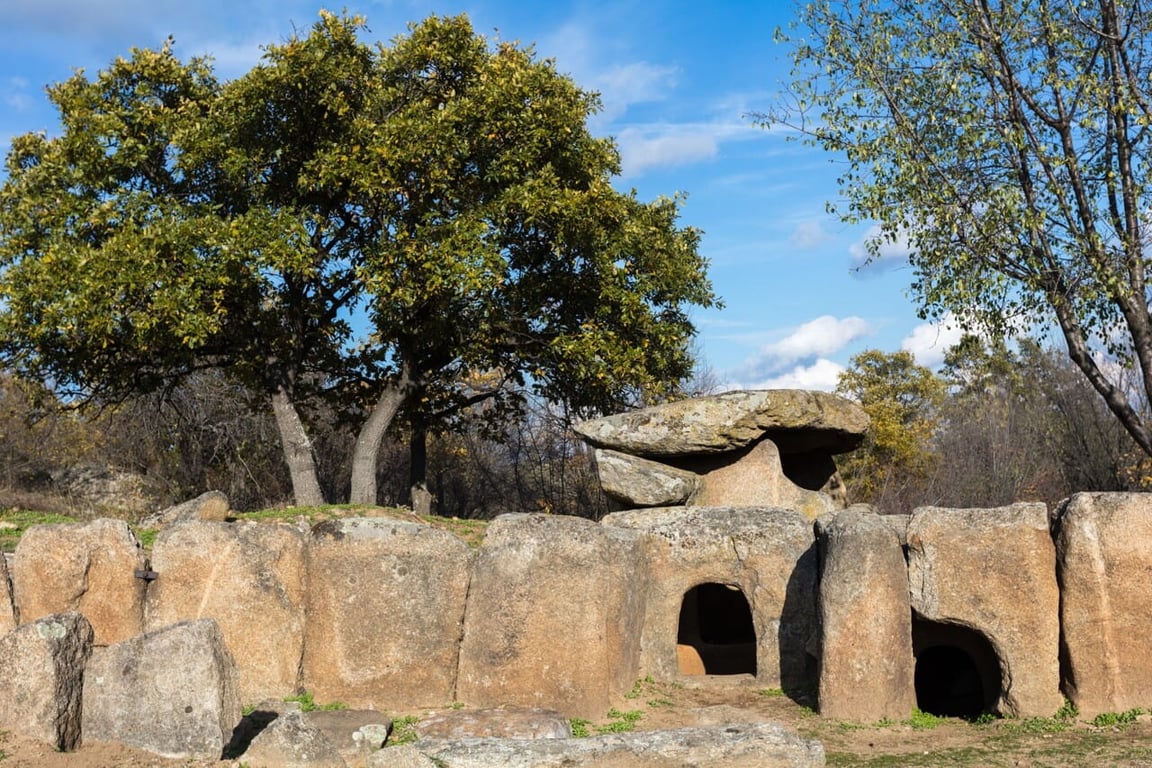
Nestled deep within the captivating landscapes of the Eastern Rhodopes in Bulgaria, The Dolmen at Hlyabovo stands as a profound testament to prehistoric human ingenuity and spiritual belief. This remarkable megalithic monument, often referred to as the "Bulgarian Stonehenge," offers a rare glimpse into the funerary practices and cultural worldview of the ancient peoples who inhabited this region millennia ago. A journey to Hlyabovo is a step back in time, inviting visitors to connect with an enduring legacy etched in stone.
A Stone Sentinel of Ancient Thrace
The origins of The Dolmen at Hlyabovo are rooted in the distant past, dating back primarily to the Late Bronze Age (around 15th-12th century BCE) and continuing into the early Iron Age. This period marks a fascinating chapter in the history of the Thracians, a collection of Indo-European tribes renowned for their rich culture, intricate art, and distinctive burial rites. The dolmen is not merely a pile of stones; it is a meticulously constructed burial chamber, reflecting a profound understanding of engineering and astronomy by its ancient builders.
Forged in Prehistory: The Dolmen's Genesis
The construction of the Hlyabovo dolmen coincides with a broader megalithic tradition found across Europe, though the Thracian dolmens possess unique characteristics. These monuments were often built for high-status individuals or families, serving as eternal resting places and focal points for ancestral veneration. The choice of location, often on prominent ridges or hills, suggests a deliberate connection to the landscape and perhaps celestial observations, underscoring the spiritual significance embedded in their genesis.
Beyond the Threshold: Unveiling the Dolmen's Form
The physical presence of The Dolmen at Hlyabovo is awe-inspiring. It is a classic example of a "gallery grave" or "passage grave" dolmen, characterized by its substantial stone slabs forming a chamber and an entrance passage. The monument typically consists of massive vertical orthostats (standing stones) supporting colossal capstones, creating an enclosed space that would have been inaccessible after the final burial. The sheer scale of the stones, some weighing several tons, speaks volumes about the collective effort and organizational skills required for its construction.
Crafting Eternity: A Glimpse into Megalithic Engineering
The architecture of the Hlyabovo dolmen is a marvel of prehistoric engineering. Without modern tools, the ancient builders meticulously quarried, transported, and positioned these immense stones. The precision with which they fitted the slabs, often without mortar, demonstrates an advanced understanding of structural integrity. The main chamber, sometimes accompanied by an antechamber, was designed to be a permanent dwelling for the deceased, a sacred space where the living could commune with their ancestors. The entrance, often facing east, west, or south, might have held symbolic importance, aligning with solstices or equinoxes.
Where Ancestors Rest: A Window into Thracian Spirituality
Archaeological investigations at The Dolmen at Hlyabovo and similar sites have revealed insights into the spiritual world of the ancient Thracians. These dolmens were not just tombs but sacred spaces, central to their belief system concerning life, death, and the afterlife. They served as gateways to the underworld, places where rituals were performed to honor the dead and ensure their journey to the next realm. The presence of grave goods, though often looted over millennia, would have included ceramics, weapons, and personal ornaments, intended to accompany the deceased.
Silent Witness: The Dolmen's Enduring Cultural Resonance
Beyond its function as a burial site, the Hlyabovo dolmen held profound cultural importance. It was a tangible link between generations, a place of memory and identity for the community. Its imposing form would have dominated the landscape, a constant reminder of ancestral power and the continuity of life. Even today, the dolmen continues to resonate, drawing archaeologists, historians, and curious visitors who seek to understand the enigmatic societies that shaped this ancient land.
Timeless Majesty: Preserving Hlyabovo's Megalithic Legacy
Today, The Dolmen at Hlyabovo stands as a protected cultural monument, a vital part of Bulgaria's rich heritage. Preservation efforts are ongoing to protect this ancient structure from the ravages of time, weather, and human impact. The site is a significant archaeological landmark, contributing immensely to our understanding of the Late Bronze and Early Iron Ages in the Balkans. Its continued existence is crucial for future generations to study and appreciate the complex societies that flourished long before recorded history.
Journey to the Past: Experiencing the Dolmen Today
Visiting the Dolmen at Hlyabovo offers a unique and contemplative experience. The site, though somewhat remote, is accessible and provides a tranquil setting for reflection. As you stand before these ancient stones, you can almost hear the whispers of the past, imagining the rituals performed and the lives lived by the Thracian people. It's an opportunity to connect with a timeless piece of human history, a testament to the enduring power of belief and the monumental achievements of our ancestors.
While the Dolmen at Hlyabovo is widely celebrated as a monumental relic of ancient funerary rites, its silent stones hold far more than just the echoes of the deceased. Beyond the well-trodden paths of conventional archaeology lies a labyrinth of lesser-known facts, tantalizing theories, and local folklore that challenge our understanding of this enigmatic structure. For those willing to look beyond the obvious, Hlyabovo reveals itself not merely as a tomb, but as a potential nexus of ancient knowledge, spiritual power, and enduring enigma.
Beyond the Burial Mound: Whispers of Another Purpose
Mainstream archaeology often categorizes Hlyabovo primarily as a tholos-type tomb, yet certain structural anomalies and overlooked details suggest a more complex, multi-functional role. For instance, the precise, almost too-perfect alignment of certain capstones and orthostats with specific astronomical events, not strictly related to solstices or equinoxes, hints at observational capabilities beyond a simple funerary marker. Some researchers point to subtle, unornamented carvings on the interior walls—barely visible unless under specific lighting conditions—that deviate from known Thracian funerary art, resembling abstract celestial maps or symbolic patterns whose meaning is lost to time. These 'hidden' markings suggest the dolmen might have served as a ritual initiation chamber, a place for astrological observation, or even a ceremonial space where the living sought connection with cosmic forces, rather than solely a resting place for the dead.
The Rhodopes' Living Stones: Lore of the Dolmen Keepers
Deep within the Rhodope Mountains, where Hlyabovo stands, the ancient stones are not merely inert monuments but living entities in the local consciousness. Far from academic texts, villagers recount tales passed down through generations. One such legend speaks of the dolmen as a "Stone Sentinel," believed to be imbued with the spirit of a giant guardian who protects the valley. It is said that on specific nights, particularly around the autumn harvest, faint, rhythmic humming can be heard emanating from within the chamber, described by some as the "lament of the ancestors" or the "song of the earth."
The Dolmen's Shadow: A Portal to the Otherworld?
Another compelling local belief posits that the Dolmen at Hlyabovo is a liminal space, a thin veil between worlds. Folk tales warn against lingering too long within its shadow at twilight, for fear of encountering spectral figures or being drawn into an ethereal realm. Conversely, some elders whisper of the dolmen possessing a 'healing touch,' claiming that a brief, silent vigil inside its chamber can alleviate ailments or bring clarity to troubled minds, suggesting a long-forgotten sacred energy associated with the site.
Architects of the Unthinkable: Hlyabovo's Impossible Geometry
The sheer scale and precision of Hlyabovo's construction continue to baffle engineers and archaeologists. The massive granite slabs, some weighing several tons, are fitted with an accuracy that seems to defy the tools and knowledge attributed to its builders. The prevailing theory of ramps and levers struggles to fully explain the placement of the colossal capstones without leaving more substantial evidence of such extensive earthworks. This has led to more unconventional proposals.
Resonance of the Ancestors: Acoustic Secrets
A fringe theory, gaining traction among enthusiasts, suggests that the dolmen's specific dimensions and stone composition might have been deliberately chosen for acoustic properties. Early, unofficial experiments have noted unusual sound resonance within the chamber, amplifying certain frequencies. Could the dolmen have been designed as a giant sound box, used for trance induction, ritualistic chanting, or to communicate across distances in ways we no longer comprehend?
A Global Thread: Hlyabovo's Echoes Across Ancient Worlds
Perhaps the most intriguing and least explored aspect of Hlyabovo lies in its subtle, yet striking, resemblances to megalithic structures far beyond the Thracian lands. While most dolmens share basic characteristics, certain architectural motifs and construction techniques at Hlyabovo have drawn comparisons to sites in the Caucasus, and even, more controversially, to some of the ancient structures found in the Korean Peninsula. These similarities go beyond superficial resemblance, touching upon specific methods of stone dressing, internal chamber layouts, and even the orientation towards particular celestial bodies.
Carved Codes: A Shared Megalithic Language?
Could these parallels hint at a forgotten, pan-Eurasian megalithic culture, or even a shared body of knowledge disseminated by an unknown ancient network? The idea of a common architectural "language" transcending vast geographical distances challenges conventional historical narratives, suggesting a level of ancient connectivity and sophistication that remains largely unacknowledged. Hlyabovo, therefore, stands not just as a monument to its local culture, but as a potential key to unlocking a much grander, global mystery.