
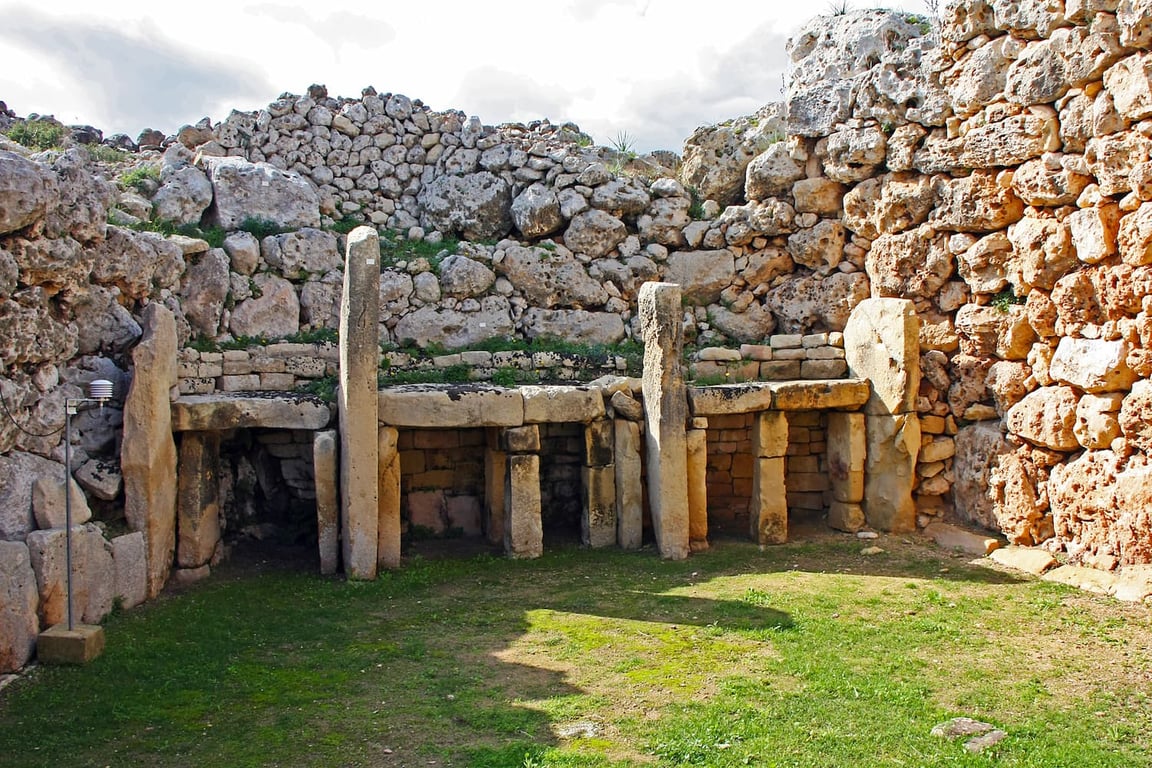
Ġgantija Temples
Rated 4.5(3,649 reviews)Age: ~5,600 years old
About Ġgantija Temples
In short
Ġgantija is a pair of megalithic temples at Xagħra on Gozo, Malta. Farming communities of the Temple Period built the South Temple around 3600 BCE and the smaller North Temple about 400 years later. Listed by UNESCO in 1980, it is now part of the Megalithic Temples of Malta World Heritage Site.
At the edge of the Xagħra plateau on Gozo, two temples stand side by side behind one curved façade of limestone blocks, some of them more than 5 meters long. Ġgantija was begun around 3600 BCE, according to the archaeologists who date it, which makes it one of the earliest freestanding stone buildings known, older than Stonehenge and the pyramids at Giza. Its name comes from ġgant, the Maltese word for giant, after the Gozitan tradition that giants raised it. In 1980 it became the first of Malta's temples on the UNESCO World Heritage List.
Who built Ġgantija, and when?
Archaeologists credit the farming communities of Malta's Temple Period, the culture that also built the Tarxien Temples, Ħaġar Qim and Mnajdra on the main island. According to Heritage Malta, the South Temple went up first, around 3600 BCE. About 400 years later the builders added a second, smaller temple on its north side, and a later generation built up a large semicircular forecourt in front of both, probably a gathering place for ceremonies. A pottery sherd decorated with a bird, from the Tarxien phase (about 3150–2500 BCE), turned up in the terrace wall in 1954, a sign that work went on into that later phase.
Archaeologists named the first great phase of temple building, usually dated about 3600–3200 BCE, after Ġgantija, and they date the phases with radiocarbon dating, which measures the decay of carbon in once-living material. The people of the temples buried their dead about 300 meters away, in the Xagħra Circle, a cave complex ringed by standing stones, excavated from 1987 to 1994.
The author and researcher Graham Hancock suggested in his 2022 Netflix series Ancient Apocalypse that the Maltese temples are much older than reported, and the Dutch researcher Lenie Reedijk dates them by their alignment to the star Sirius. Their readings, and the giantess of Gozitan tradition, are in Beyond.
Is Ġgantija the oldest building in the world?
For years Ġgantija was promoted as the world's oldest freestanding structure. That title faded once the stone enclosures of Göbekli Tepe in Turkey, built from about 9600 BCE, became widely known, and Heritage Malta now calls Ġgantija one of the earliest. By the excavators' dates, its South Temple is about 600 years older than the first earthwork at Stonehenge, dug around 3000 BCE, and roughly 1,000 years older than the Great Pyramid, built around 2600 BCE.
What you see at Ġgantija
The two temples share an outer wall and a single façade but have separate entrances. The façade curves inward and faces southeast, as most Maltese temples do. At its unrestored southern corner the wall still stands about 7 meters high.
- South Temple: the older, larger and better preserved of the pair, with five apses, or D-shaped chambers, opening off a central corridor.
- North Temple: smaller, with four apses and a modest niche at the far end where the fifth apse would be.
Hard coralline limestone, which stands up well to the weather, went into the outer walls and helps explain why so much still stands. Softer globigerina limestone, easier to shape, was kept for doorways, altars and decorated slabs, and was brought uphill from more than a kilometer away.
How heavy the largest blocks are is still discussed. Heritage Malta says some weigh more than 50 tons, while a 2013 exhibition at New York University estimated the largest at about 21 tons, with most between half a ton and a little over 2 tons. Stone balls found here and at other temples may have served as rollers, with levers, earth ramps and ropes doing the rest.
What was Ġgantija used for?
Inside, stone hearths show that fires were lit, holes in the floor may have received liquid offerings, and animal bones may be the remains of sacrifices. Two fragments of plaster painted with red ochre show that the inner walls were plastered and colored. A slab carved with a snake, now faint, is kept in the Gozo Museum of Archaeology.
The FRAGSUS project, which studied Malta's temple culture from 2013 to 2018, surveyed the ground around Ġgantija with geophysics and soil science. Its 2020 report describes a close link between the temple and a spring, signs that Neolithic people managed the soil, and evidence of everyday and economic work inside the temple area. The archaeologist Marija Gimbutas, who traced goddess imagery across Neolithic Europe, read the rounded walls of Maltese temples as the body of a goddess, an idea that is still debated.
How Ġgantija was cleared and recorded
Unlike Tarxien, which lay under farmland until 1913, Ġgantija was never lost: its upper walls stood in plain view. The French artist Jean-Pierre Houël drew a plan of the ruins in the late 18th century that was later found to be accurate.
In the 1820s John Otto Bayer, the British official in charge of Gozo, had the site cleared of earth and debris at his own expense. It was the first Maltese prehistoric monument to be cleared, and the street to it now carries his name. The soil and everything in it were thrown away without study, so the layers that could have shown how the temples were used are gone. The best record of what the clearance revealed is a set of watercolors painted around 1828 by Charles de Brocktorff, which also preserve spiral reliefs that have since weathered away.
Further excavations took place in 1933, 1936, 1949 and 1956–1959. In 1992 UNESCO extended Ġgantija's listing to Ħaġar Qim, Mnajdra, Tarxien, Skorba and Ta' Ħaġrat and renamed it the Megalithic Temples of Malta.
Visiting Ġgantija
Heritage Malta runs the site as the Ġgantija Archaeological Park in Xagħra. Visitors enter through an Interpretation Centre, opened in 2013, which shows finds from prehistoric sites across Gozo, including the red-ochre plaster. A path through open country leads to the temples, where lightweight walkways installed in 2011 protect the prehistoric floors. A visit takes about an hour, and the site is fully accessible to visitors with reduced mobility.
Beyond: more about Ġgantija Temples
Checking…
Contributors
No contributions yet
Be the first to add photos or videos!
Play and learn
Test Your Knowledge!
Think you know everything about Ġgantija Temples? Take our interactive quiz and become an Ancient Sites Expert!
Frequently asked questions
How old are the Ġgantija temples?
Archaeologists, working from radiocarbon dates, place the South Temple around 3600 BCE and the North Temple about 400 years later. Graham Hancock proposes that the Maltese temples are much older, and Lenie Reedijk's Sirius chronology runs the temple period from about 9150 to 4250 BCE.
Is Ġgantija older than Stonehenge and the pyramids?
By the excavators' dates, yes: its South Temple, from around 3600 BCE, is about 600 years older than the first earthwork at Stonehenge and roughly 1,000 years older than the Great Pyramid of Giza. Göbekli Tepe in Turkey is far older still.
What does Ġgantija mean?
The name comes from ġgant, the Maltese word for giant. It reflects the Gozitan tradition that giants, or in one tale a giantess, built the temples.
Was Ġgantija built by giants?
Gozitan tradition credits a giantess, often called Sansuna, who carried the stones with her child on her shoulder. Archaeologists credit Neolithic farming communities using stone rollers, levers, ramps and ropes. Both start from the sheer size of the blocks.
How heavy are the stones at Ġgantija?
Estimates differ. Heritage Malta says some megaliths are more than 5 meters long and weigh over 50 tons, while a 2013 exhibition estimated the largest at about 21 tons and most blocks at between half a ton and a little over 2 tons.
Can you visit Ġgantija?
Yes. Heritage Malta runs the Ġgantija Archaeological Park in Xagħra, Gozo. Entry is through an Interpretation Centre that displays finds from Gozo's prehistoric sites, and a visit takes about an hour.
Related Tags
Sources
- heritagemalta.mt/explore/ggantija-archaeological-park
- artsandculture.google.com/story/uwWxIjbBX818IA
- heritagemalta.mt/?p=4794
- heritagemalta.mt/explore/hagra-ta-sansuna
- isaw.nyu.edu/exhibitions/malta/temple-and-tomb
- um.edu.mt/library/oar/handle/123456789/84615
- um.edu.mt/library/oar/handle/123456789/7670
- gozoalbum.gov.mt/album/photo/ggantija-temples/f5035dff8f32741
- gozoalbum.gov.mt/album/photo/ggantija-temples--the-sculpted-snake/2100df13a8361c1
- xaghralc.gov.mt/en/historical-places
- the-past.com/feature/the-brochtorff-stone-circle-at-xaghra-malta
- english-heritage.org.uk/visit/places/stonehenge/history-and-stories/history
- en.wikipedia.org/wiki/%C4%A0gantija
- en.wikipedia.org/wiki/Megalithic_Temples_of_Malta
- whc.unesco.org/en/list/1572
- grahamhancock.com/ancient-apocalypse
- maltatoday.com.mt/comment/opinions/120362/ancient_apocalypse_you_cant_be_sirius_pt_2
- grahamhancock.com/reedijkl1
- bdlbooks.com/authors/lenie-reedijk
- eprints.bournemouth.ac.uk/40855
- repository.cam.ac.uk/handle/1810/315523
- bmcr.brynmawr.edu/?p=21564
- ahotcupofjoe.net/2022/11/graham-hancocks-ancient-apocalypse-a-review-of-episodes-three-and-four
Other Sites You Might Like
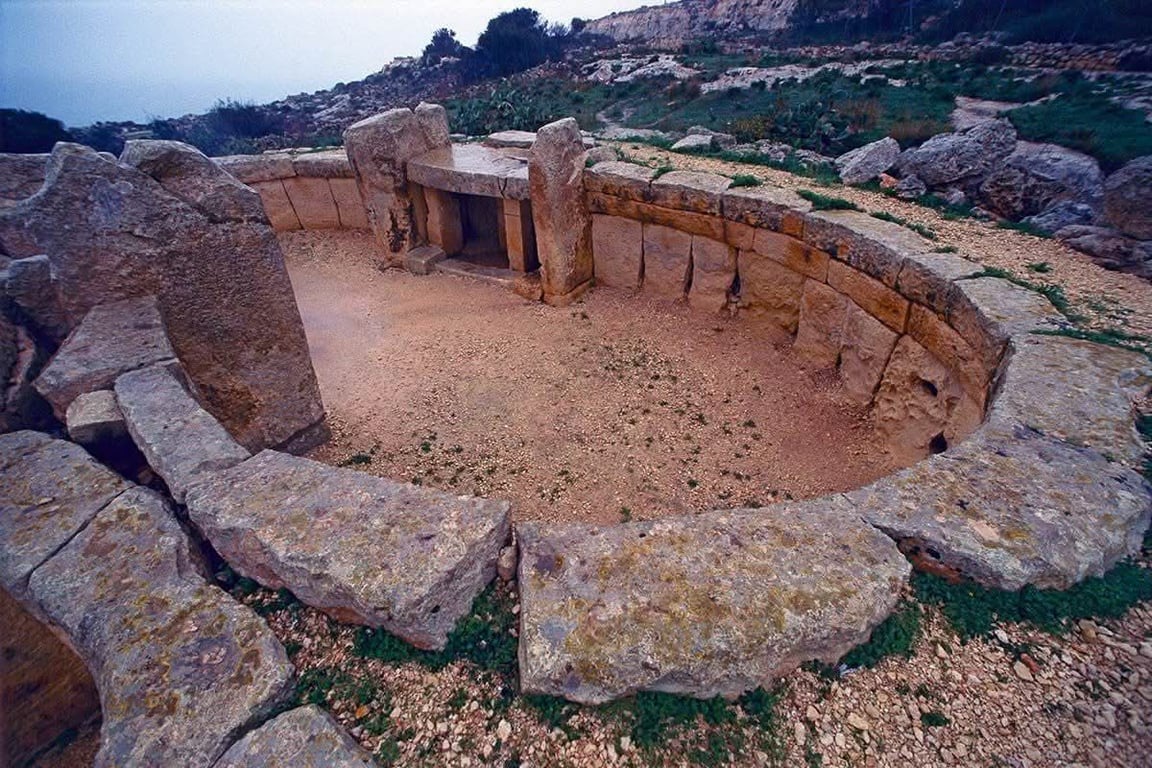 Malta
Mnajdra Archaeological Park
Three Neolithic temples above Malta's south coast, one of them facing the equinox sunrise through its doorway.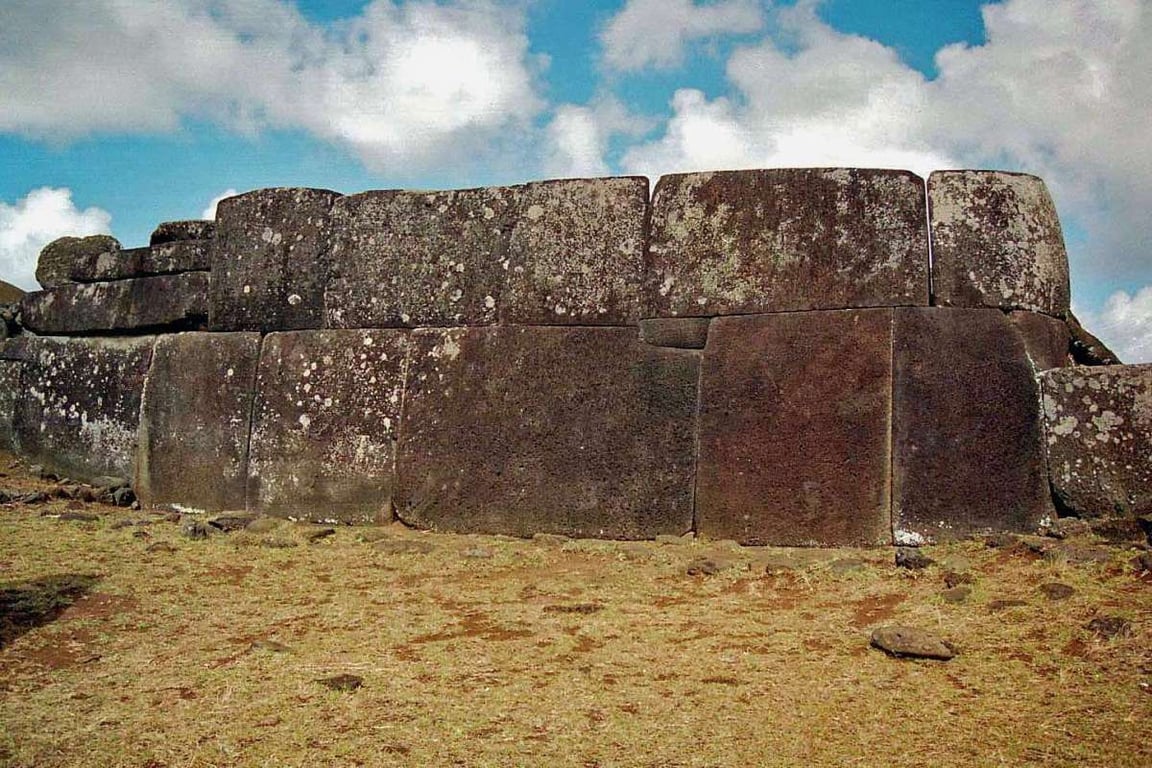 Chile
Ahu Vinapu
Two ceremonial platforms on Rapa Nui's south coast, one backed by basalt slabs so finely fitted they are compared to Inca walls.- Syria
Ain Dara Temple
An Iron Age temple in northwest Syria where meter-long carved footprints stride from the porch toward the god's inner hall. 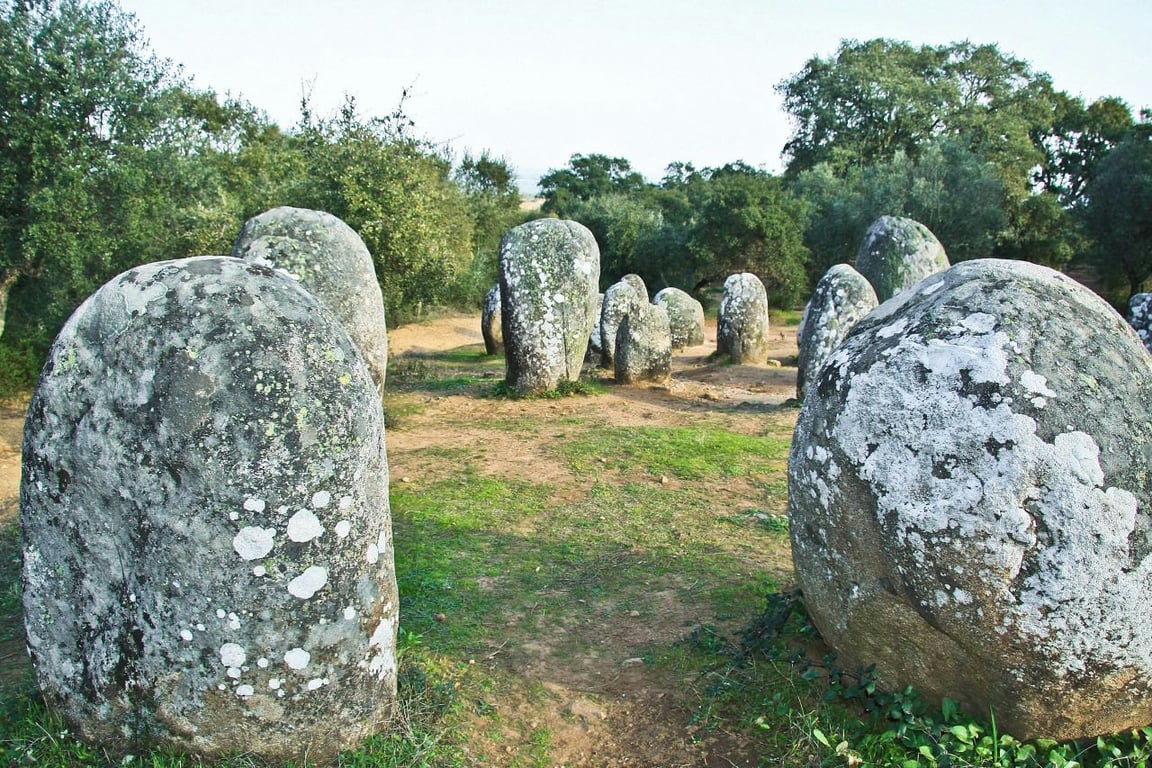 Portugal
Almendres Cromlech
About 95 granite menhirs on an Alentejo hillside, raised and reshaped by Neolithic communities from roughly 7,000 years ago. Tunisia
Amphitheatre of El Jem
A three-story Roman arena for some 30,000 spectators, still towering over the Tunisian town that grew up around it. Greece
Ancient Marble Thrones
Five marble seats of honor ring the orchestra of a small theater at the Amphiareion, a healing sanctuary north of Athens.