
Ħaġar Qim Temples
Rated 4.5(3,500 reviews)Age: Neolithic, ~5,600 years old
About Ħaġar Qim Temples
In short
Ħaġar Qim is a megalithic temple complex on a ridge near Qrendi, on Malta's south coast. Its main building dates to about 3600–3200 BCE, the Ġgantija phase of Malta's Neolithic Temple Period. First excavated in 1839, it is part of the UNESCO World Heritage Site Megalithic Temples of Malta.
Ħaġar Qim stands on a bare limestone ridge near Qrendi, high above Malta's south coast. Its outer wall holds the temple's biggest stones: one slab is 5.2 meters tall, and another is estimated at close to 20 metric tons. The main building went up around 3600–3200 BCE, more than 5,000 years ago, and looks out over the open sea and the islet of Filfla. With Mnajdra, 500 meters downhill, it is part of the UNESCO World Heritage Site Megalithic Temples of Malta.
Who built Ħaġar Qim, and when?
Ħaġar Qim belongs to Malta's Temple Period, when the islands' Neolithic farming communities raised megalithic buildings between about 3600 and 2500 BCE. The same culture built Tarxien and Ġgantija and cut the Ħal Saflieni Hypogeum. Archaeologists divide the period into phases named after those sites, and date the main building at Ħaġar Qim to the Ġgantija phase.
The complex was not built in one go. Archaeologists think the main temple grew in stages, and the ruins on its north side may be older still. The builders left no writing, so what the temple meant to them has to be read from the stones and the objects left inside. Its Maltese name is usually translated as “standing stones”, although qim may instead come from the word for worship.
What you see at Ħaġar Qim today
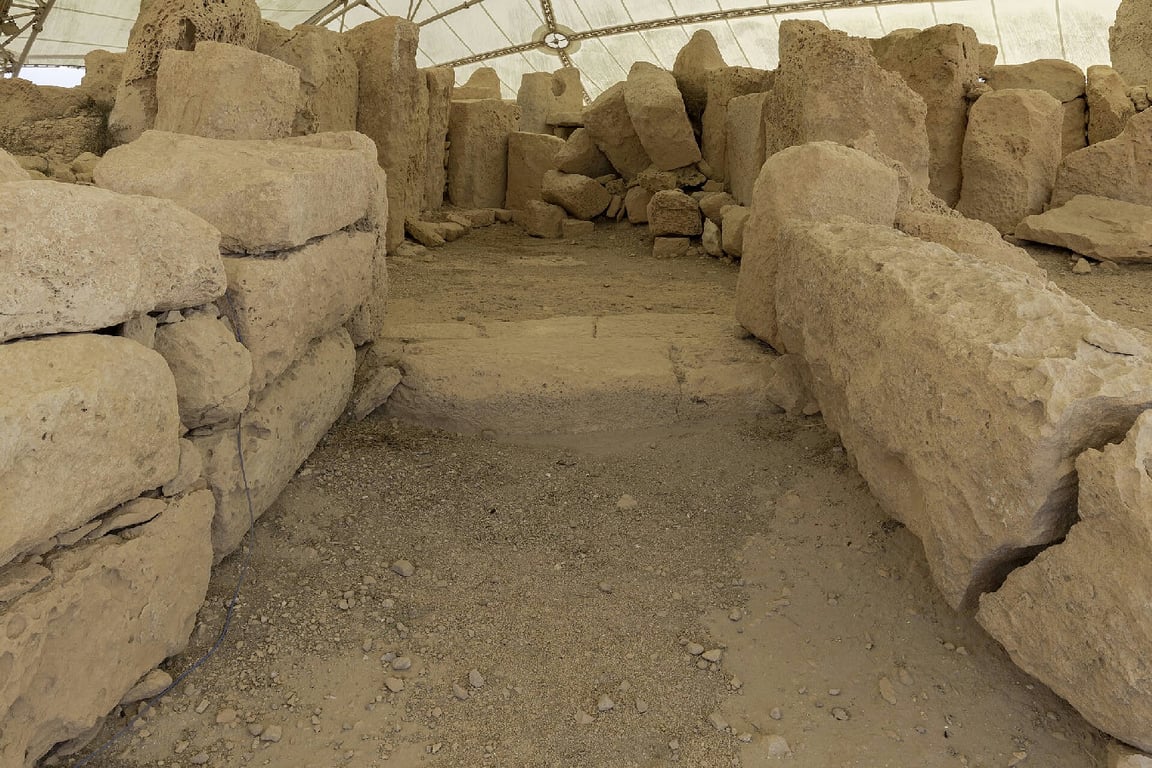
The main temple faces southeast across an oval forecourt. Its entrance is a trilithon, two uprights capped by a horizontal lintel, set in a façade whose top slabs are notched into massive corner blocks. Inside, a central passage paved with stone slabs runs between C-shaped rooms, called apses, with floors of beaten earth. Some inner doorways are trilithons; others are “porthole” doorways cut through a single slab.
The plan is unusual. The main building has extra doorways along its outer wall, its northwestern end was replaced by four separate enclosures, and the remains of at least two more structures stand beside it. The biggest stones sit in the outer wall, where they were not needed for support; the National Museum of Archaeology suggests they were placed there to show what the builders could do.
Parts of the building were once roofed with courses of stone stepped inward. None of these roofs survives, but the carved ceilings of the Hypogeum suggest how they may have looked. In one chamber, an elliptical hole cut through a slab lines up with sunrise at the summer solstice, when it throws a patch of light onto a slab inside. The whole complex is built of globigerina limestone, the soft stone that caps the ridge: easy to carve, but quick to weather, and the outer walls show heavy flaking.
Altars, spirals and stone figures
Two of Ħaġar Qim's best-known carvings are a slab decorated in relief with a pair of opposing spirals and a free-standing, four-sided pillar carved with plant-like designs, often described as an altar. Copies now stand in the temple; the originals are indoors, one in the National Museum of Archaeology in Valletta and one in the park's visitor center. Low stone altars along the walls were once decorated with drilled pits.
The site also produced several of the corpulent human figures typical of Malta's temple culture, all now in the National Museum of Archaeology. They include the clay “Venus of Malta”, just 13 centimeters tall, a limestone standing figure almost half a meter high, and four seated statues found together under a step into a small one-apsed annex. Who these figures represent is one of the open questions at Ħaġar Qim, along with why the temple faces southeast and how old Malta's temple culture is. Archaeologists, archaeoastronomers and independent researchers, among them Cristina Biaggi and the author Graham Hancock, read them in different ways, set out side by side in Beyond.
How Ħaġar Qim was rediscovered
Ħaġar Qim was never completely buried. Its tallest stones stood above the fields for centuries, and the Maltese historian Giovanni Francesco Abela described the ruins as early as 1647. The oldest known picture of the site, published in 1787 by the French artist Jean-Pierre Houël, shows tall megaliths rising from mounds of earth in farmland.
Excavation began in 1839, when the British colonial government paid for the site to be cleared under J. G. Vance of the Royal Engineers. The finds included stone statuettes, a decorated altar and a decorated slab. Antonio Caruana dug again in 1885, Themistocles Zammit and Thomas Peet in 1909, and the British School at Rome surveyed and repaired the structures in 1910. Much of the main façade seen today was rebuilt in the first half of the 20th century.
Protecting the temple
Once cleared, the soft stone was exposed to rain, sun, wind and salt. Repeated wetting and drying, heating and cooling broke up its surfaces and washed out the earth fill inside the walls, and in November 1998 part of the temple collapsed.
Since 2009 Ħaġar Qim and Mnajdra have stood under lightweight shelters of fabric stretched over steel arches, designed by the Swiss architect Walter Hunziker after an international competition. Heritage Malta describes them as a stopgap until other ways of preserving the stone have been tested. When the arches rose over Ħaġar Qim in December 2008, many people objected to the change in a familiar skyline; the curators report that most visitors now like the soft, even light under the membrane, which brings out the color and texture of the stone.
Visiting Ħaġar Qim
Ħaġar Qim is the first stop in the Ħaġar Qim and Mnajdra Archaeological Park, run by Heritage Malta near Qrendi. The visitor center has an exhibition, with a section on the conservation problems, and a short 4D film. The visitor center and Ħaġar Qim are wheelchair accessible, though some assistance is needed at the temple; Mnajdra, about 500 meters downhill along a footpath, is not. Heritage Malta suggests allowing 90 minutes to three hours for the whole park.
Beyond: more about Ħaġar Qim Temples
Checking…
Contributors
No contributions yet
Be the first to add photos or videos!
Play and learn
Test Your Knowledge!
Think you know everything about Ħaġar Qim Temples? Take our interactive quiz and become an Ancient Sites Expert!
Frequently asked questions
How old is Ħaġar Qim?
Archaeologists date the main temple to around 3600–3200 BCE, the Ġgantija phase of Malta's Temple Period, and think the complex grew in stages, with its northern ruins perhaps older. The author Graham Hancock proposes that Malta's temples may be far older; Maltese archaeologists point to radiocarbon and luminescence dates within the Temple Period.
What does Ħaġar Qim mean?
Ħaġar means stones in Maltese. Qim is usually read as an old form of the word for standing, giving “standing stones”, but it may instead come from the word for worship.
Were the Ħaġar Qim figures goddesses?
Readings differ. Cristina Biaggi, building on Marija Gimbutas, sees a goddess beyond male and female, while Anthony Bonanno reads the sexless figures as a balance of male and female principles, perhaps ancestors; the National Museum of Archaeology says they could represent men or women.
Is Ħaġar Qim linked to Atlantis?
In Ancient Apocalypse (2022), Graham Hancock links Malta's temples to a civilization he believes was lost at the end of the last Ice Age, which MaltaToday's review says he identifies with Atlantis. Archaeologists such as Anthony Bonanno of the University of Malta note that nothing older than the Neolithic has yet been found on Malta, and the question of earlier arrivals is still open.
Why is there a tent over Ħaġar Qim?
The soft globigerina limestone was crumbling after more than a century and a half of exposure, and part of the temple collapsed in 1998. Fabric shelters on steel arches, completed in 2009, protect it from sun and rain while longer-term methods are tested.
Can you visit Ħaġar Qim and Mnajdra together?
Yes. Both are in the Ħaġar Qim and Mnajdra Archaeological Park, run by Heritage Malta, with a shared visitor center; Mnajdra is about 500 meters downhill by footpath.
Related Tags
Sources
- heritagemalta.mt/explore/hagar-qim-and-mnajdra-archaeological-park
- digitaltwin.heritagemalta.mt/?p=24
- heritagemalta.mt/news/hagar-qim-mnajdra-temples-open-for-free-on-saturday-10th-february
- whc.unesco.org/en/list/132
- artsandculture.google.com/story/9QWhkozZ9yNvKQ
- artsandculture.google.com/story/sQXRnxEqSHvuJg
- um.edu.mt/library/oar/bitstream/123456789/15852/1/The%20Protective%20Shelters%20at%20%c4%a6a%c4%a1ar%20Qim%20and%20Mnajdra%20%20Impacts%2c%20dilemmas%20and%20values.pdf
- isaw.nyu.edu/exhibitions/malta/checklist
- um.edu.mt/library/oar/handle/123456789/38232
- um.edu.mt/library/oar/handle/123456789/12118
- en.wikipedia.org/wiki/%C4%A6a%C4%A1ar_Qim
- en.wikipedia.org/wiki/Megalithic_Temples_of_Malta
- en.wikipedia.org/wiki/Giovanni_Francesco_Abela
- heritagemalta.mt/news/new-4d-experience-at-hagar-qim-visitor-centre
- artsandculture.google.com/story/uwWxIjbBX818IA
- um.edu.mt/library/oar/handle/123456789/84615
- fhsev.de/Wolfschmidt/events/pdf/albrecht-malta.pdf
- preistoriainitalia.it/en/2022/03/04/le-abitazioni-della-dea-cristina-biaggi
- thetvdb.com/series/ancient-apocalypse-2022/episodes/9445161
- maltatoday.com.mt/news/interview/119921/megalithic_malta_lost_city_atlantis_anthony_bonanno
- maltatoday.com.mt/comment/opinions/120362/ancient_apocalypse_you_cant_be_sirius_pt_2
- ahotcupofjoe.net/2022/11/graham-hancocks-ancient-apocalypse-a-review-of-episodes-three-and-four
Other Sites You Might Like
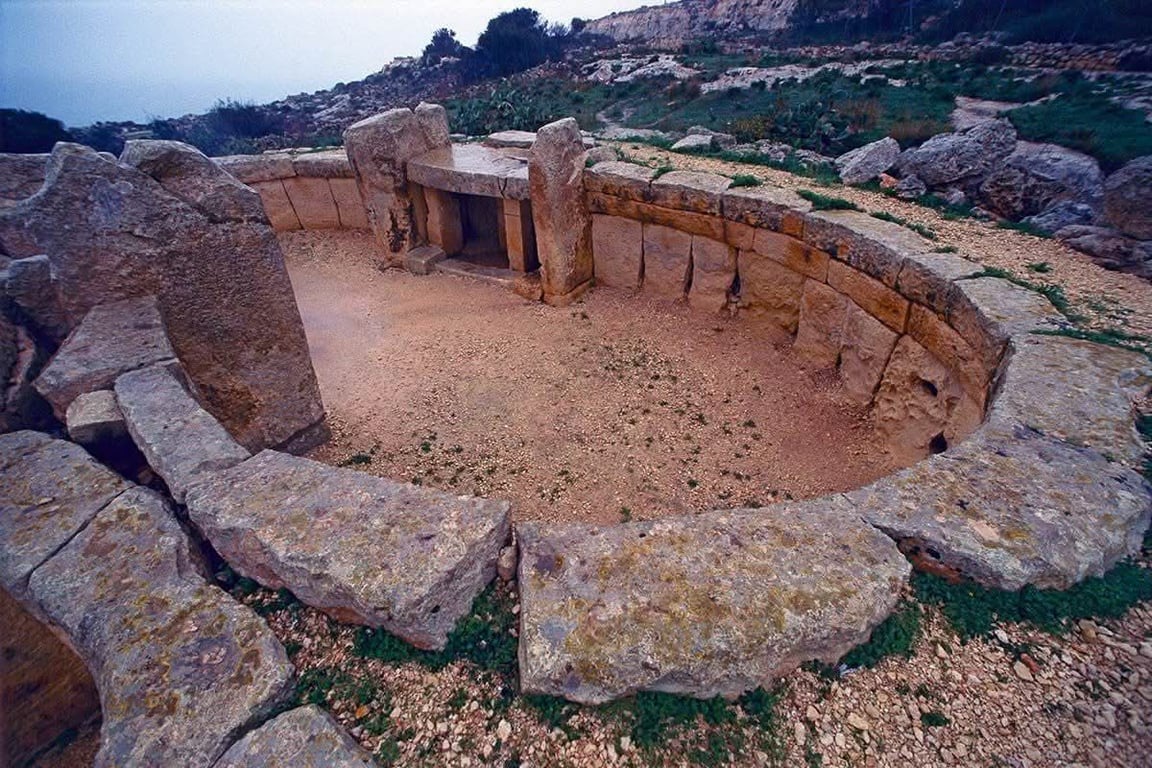 Malta
Mnajdra Archaeological Park
Three Neolithic temples above Malta's south coast, one of them facing the equinox sunrise through its doorway.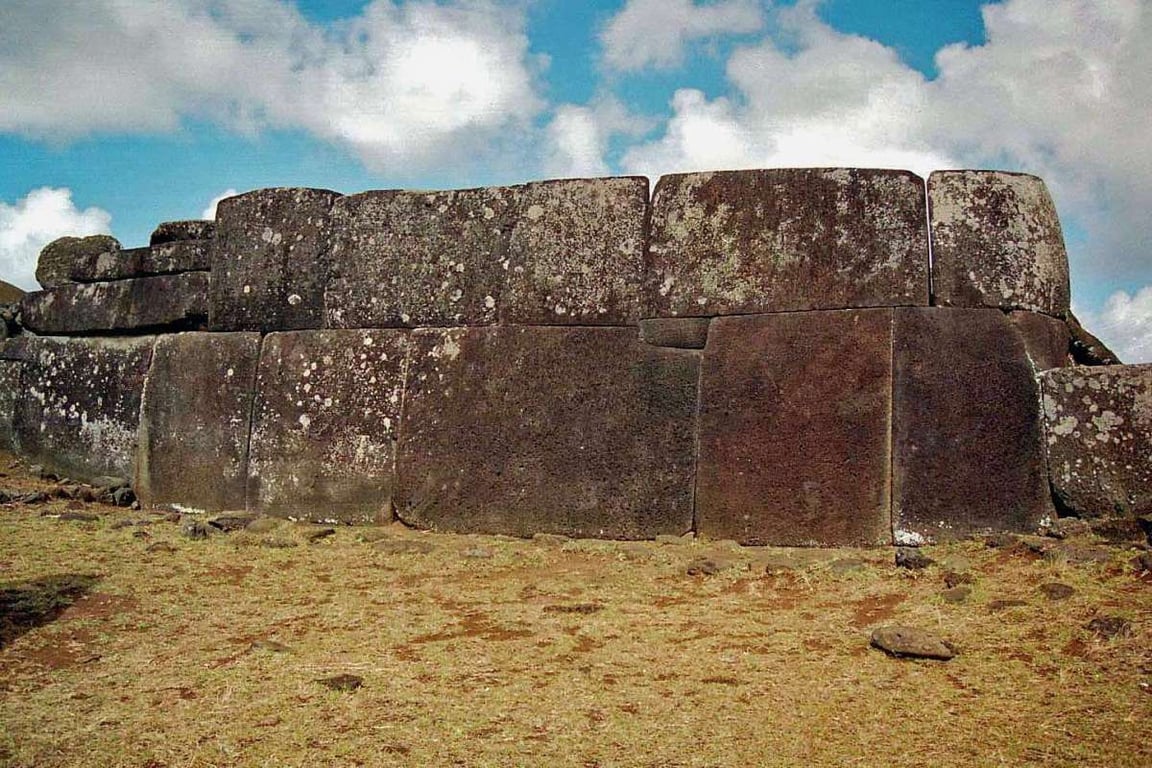 Chile
Ahu Vinapu
Two ceremonial platforms on Rapa Nui's south coast, one backed by basalt slabs so finely fitted they are compared to Inca walls.- Syria
Ain Dara Temple
An Iron Age temple in northwest Syria where meter-long carved footprints stride from the porch toward the god's inner hall. 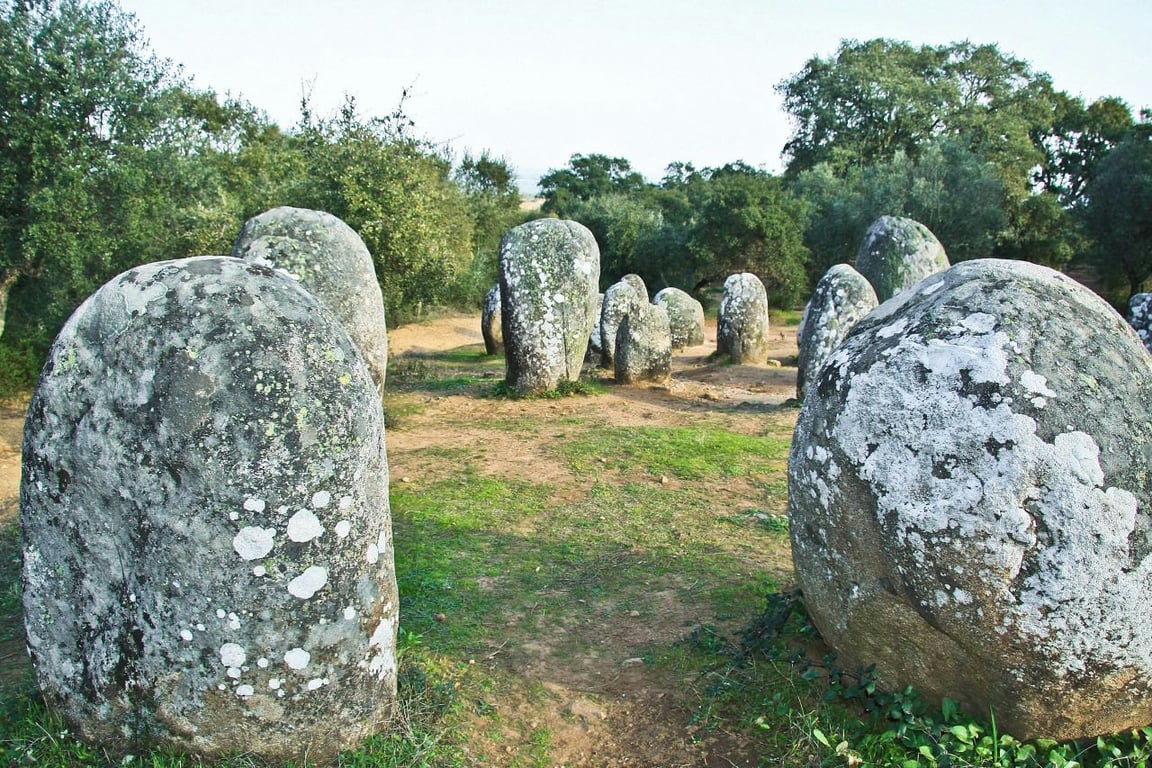 Portugal
Almendres Cromlech
About 95 granite menhirs on an Alentejo hillside, raised and reshaped by Neolithic communities from roughly 7,000 years ago. Tunisia
Amphitheatre of El Jem
A three-story Roman arena for some 30,000 spectators, still towering over the Tunisian town that grew up around it. Greece
Ancient Marble Thrones
Five marble seats of honor ring the orchestra of a small theater at the Amphiareion, a healing sanctuary north of Athens.