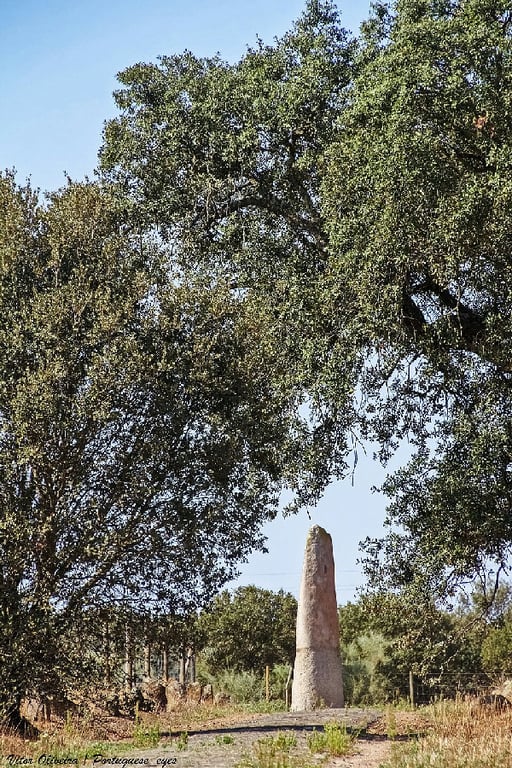
Menir da Bulhoa
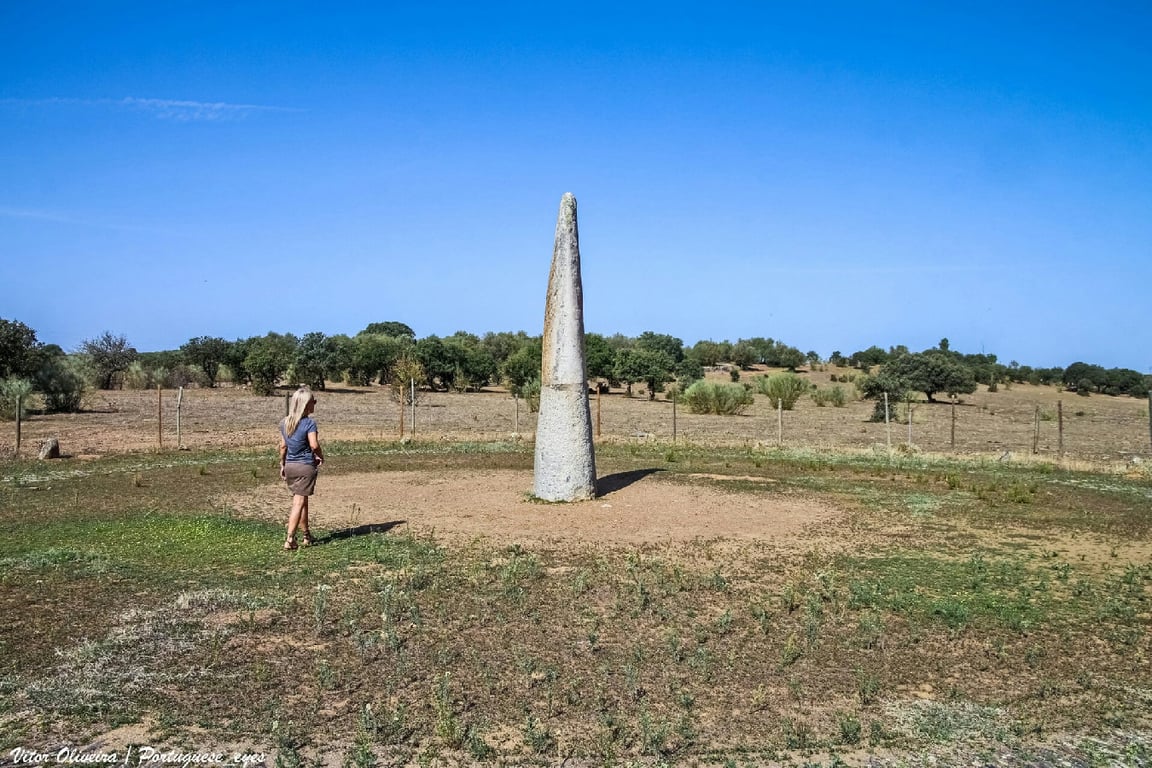
Rescued from a grape press and re-erected, this 4-meter menhir is a canvas of enigmatic Neolithic engravings. Its fractured form tells a story of loss and rediscovery.
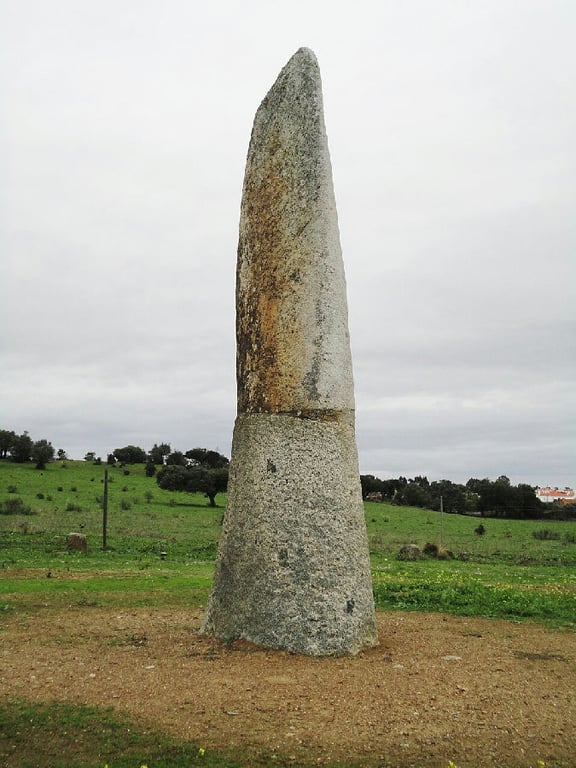
Menir da Bulhoa
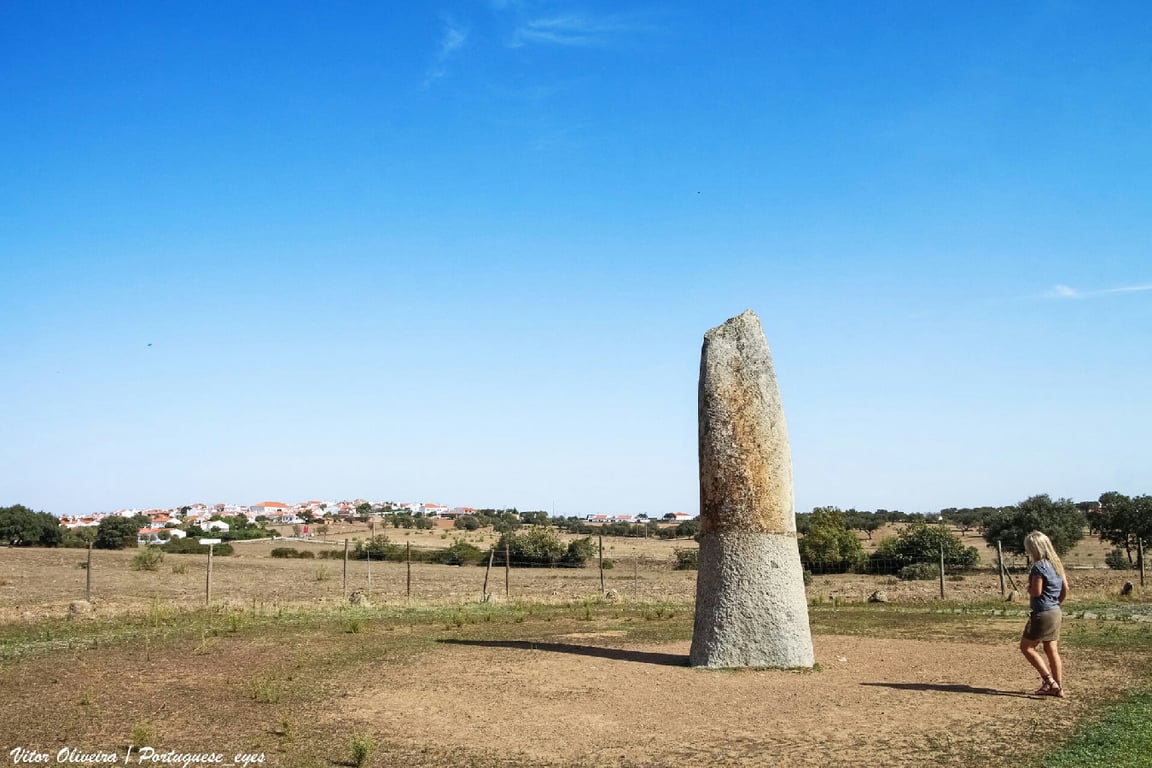
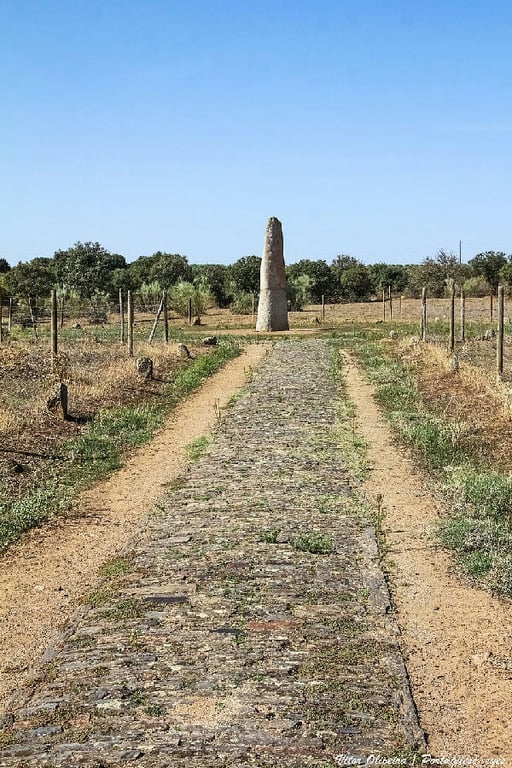
Just outside the village of Telheiro, in the rich megalithic territory of Reguengos de Monsaraz, stands the Menir da Bulhoa. Though not as tall as its famous neighbour, the Menir do Outeiro, this four-metre-high standing stone tells a more dramatic story of loss, discovery, and restoration. For centuries it lay forgotten, its upper part fractured from its base and repurposed as a counterweight in a nearby grape press. It was only in 1970 that its true identity was recognised, leading to its painstaking restoration and re-erection. Today, it stands proud once more, its visible fracture a permanent scar that testifies to its remarkable journey through time. It is not just a prehistoric monument but also a symbol of cultural resilience and the enduring power of heritage.
A Canvas of Neolithic Symbols
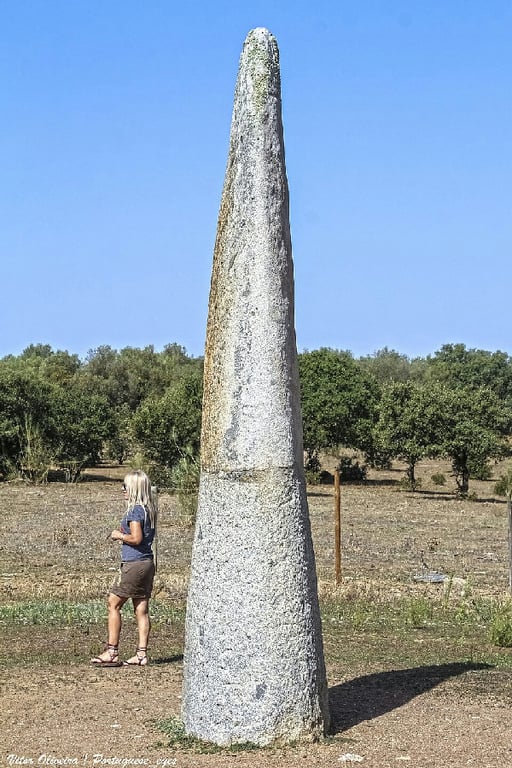
What truly sets the Menir da Bulhoa apart is its surface, which is richly decorated with enigmatic engravings. Unlike the stark simplicity of many other menhirs, this stone is a canvas of Neolithic art, covered in symbols whose meanings are now lost to us but were undoubtedly profound for its creators. The carvings, though faint after millennia of erosion, are clearly visible in the right light. They consist of a captivating array of motifs, including wavy lines, serpentine forms, circles, and radiating symbols that could represent the sun or stars. These engravings place the menhir among a select group of decorated standing stones in Western Europe. The serpentine figures might relate to water, spirits, or cycles of renewal, while the geometric shapes could be tribal insignia, astronomical maps, or representations of spiritual concepts. Each mark is a faint echo from a pre-literate society, a form of communication and expression carved in the most permanent medium available to them.
A Story of Ruin and Rebirth
The modern history of the Menir da Bulhoa is as compelling as its ancient origins. Discovered lying flat in the Herdade da Bulhoa (Bulhoa Estate), its true significance was not immediately apparent. The main shaft of the menhir had been broken in two, and the larger, upper piece had been transported to a local winery to be used in a 'lagar', a traditional press for grapes or olives. The base remained half-buried in the field. This utilitarian reuse of a sacred, 5,000-year-old monument is a poignant illustration of how the memory and meaning of such places can fade over time. Following its identification by archaeologist Henrique Leonor Pina, a careful process of recovery and restoration was undertaken. The two pieces were rejoined, with the fracture line left visible, and the whole stone was set in concrete and raised to its original vertical position close to where it was found. This act of reclamation transformed it from a forgotten, broken stone into a celebrated National Monument.
The Stone in its Place
Like other megaliths in the Monsaraz region, the Menir da Bulhoa was a vital part of its landscape. It likely functioned as a territorial or spiritual marker, situated within a dense network of dolmens and other standing stones. Its elaborate decorations suggest it was a site of particular importance, perhaps a focal point for rituals or ceremonies. Its restoration allows us not only to appreciate the artistry of its Neolithic carvers but also to better understand the layout and significance of this extraordinary prehistoric ritual landscape. It is a powerful reminder of what can be lost and what, through dedicated effort, can be saved.
The Sentinel of Telheiro: Beyond Menir da Bulhoa
While its restoration from a forgotten vineyard counterweight is a compelling tale of archaeological recovery, the true story of Menir da Bulhoa transcends its modern rediscovery. This granite-porphyry pillar is not merely a relic but a silent witness to millennia of forgotten rituals, celestial alignments, and whispered folklore. To stand before it is to feel the faint pulse of a purpose far older and more enigmatic than its documented history suggests, a purpose encoded in its very substance and placement upon the Alentejan plain.
Echoes in the Granite
Archaeologists note its ovoid, almost lenticular shape, a form distinct from the more aggressively phallic monoliths in the region. This was no arbitrary choice. Esoteric researchers propose that such forms were intended to represent a cosmic egg or a seed, a symbol of creation and fertility planted directly into the womb of the Earth. The stone itself, a coarse-grained granite-porphyry, is rich in quartz crystals. Some theorists in the field of archaeoacoustics and earth energies speculate that this specific composition was chosen for its piezoelectric properties, believing the menhir could act as a transducer—converting the planet's subtle telluric currents into perceptible energy or sound during ritual ceremonies.
A Node in a Sacred Network
The Menir da Bulhoa does not stand in isolation. It is a key point within a vast sacred landscape, a "megalithic circuit" that includes the towering Menir do Outeiro and the nearby Cromlech of Xerez. Conventional thought sees these as separate sites, but fringe theories suggest they form a single, interconnected ceremonial complex. The placement of Bulhoa is believed to be deliberate, acting as a navigational or energetic marker within this grand design, its purpose intrinsically linked to the functions of its larger neighbours.
The Lunar Alignment Heresy
While many megaliths are tied to solar events like the solstices, a compelling alternative theory argues that Menir da Bulhoa was a lunar marker. Its specific orientation, when viewed from the now-vanished Mamoa of Bulhoa (a burial mound), may have aligned perfectly with the major lunar standstill, a more complex and less frequent 18.6-year cycle of the moon's rising and setting. This would imply a highly sophisticated astronomical knowledge dedicated to lunar, rather than solar, worship—a practice often associated with feminine deities and nocturnal rites.
Where Giants Sleep and Gold Lies Hidden
Beyond academic debate, the menhir lives in the folklore of the region. The stories are not of its use in a grape press, but of far more ancient and magical origins.
The Curse of the Moura Encantada
Local legend offers a different reason for the stone’s fracture. It is said to mark the location of a hidden Moorish treasure, guarded by a supernatural maiden, a Moura Encantada. The stone was not broken by time or neglect, but shattered by the greed of treasure hunters who attempted to unearth the gold. Their failure invoked the Moura's curse, breaking their tools and the sacred stone itself, which then lay dormant for centuries until its spirit was appeased by its rightful recognition and re-erection. To this day, some locals believe that on nights of the full moon, the Moura's sigh can be heard rustling the wild grasses at the menhir's base.
Menir da Bulhoa — photo gallery