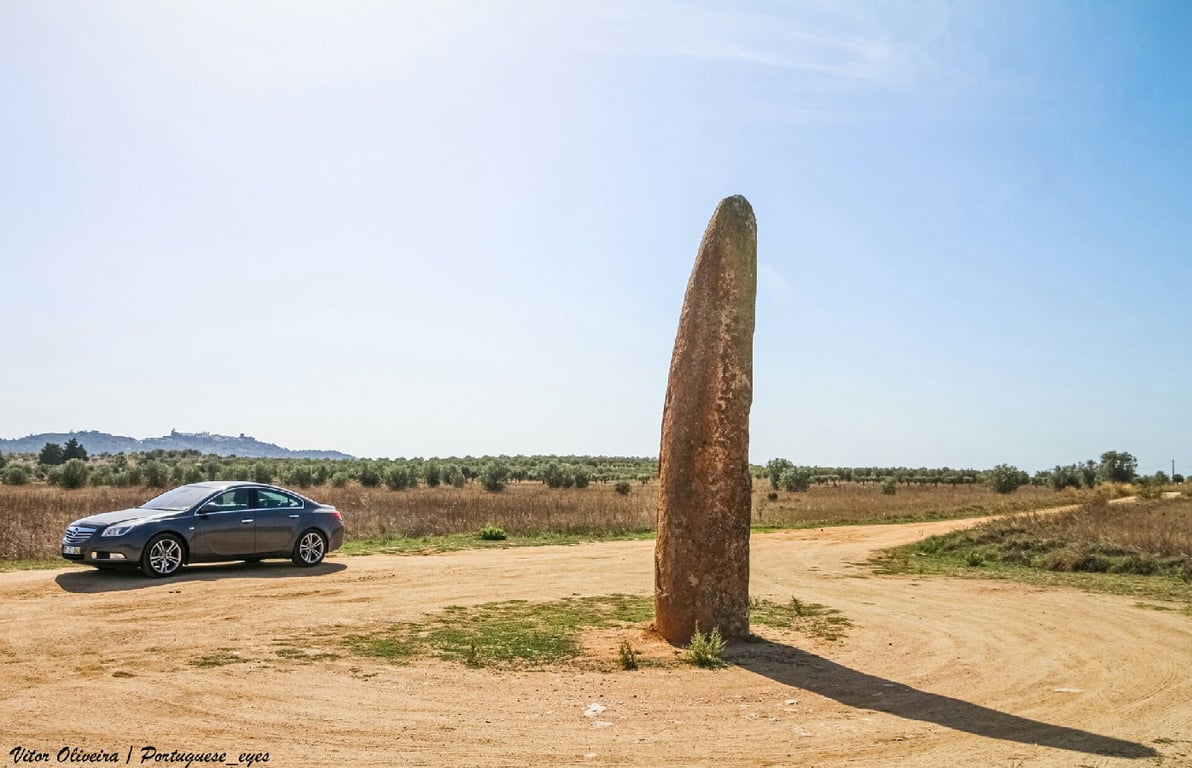
Menir do Outeiro
One of Europe's tallest phallic menhirs, this 5.6-meter granite giant has surveyed the Alentejo plains for nearly 6,000 years. A colossal fertility symbol from a forgotten time.
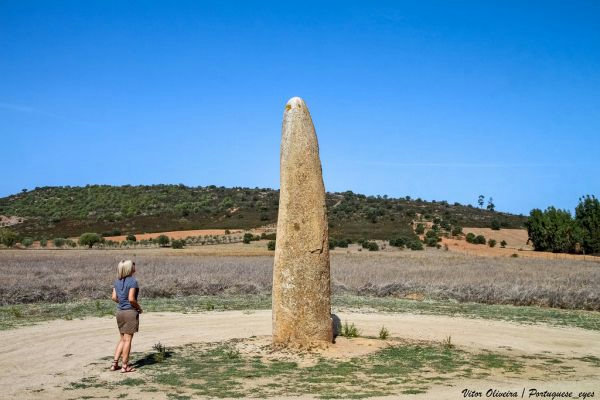
Menir do Outeiro
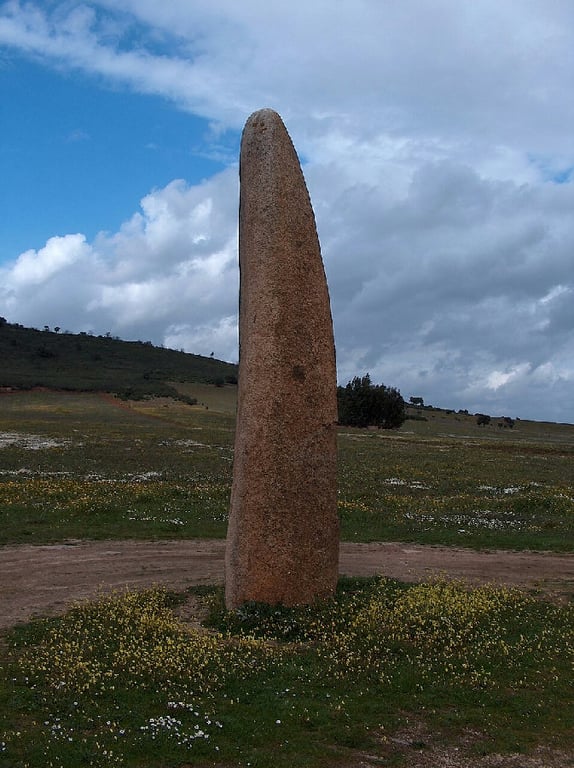
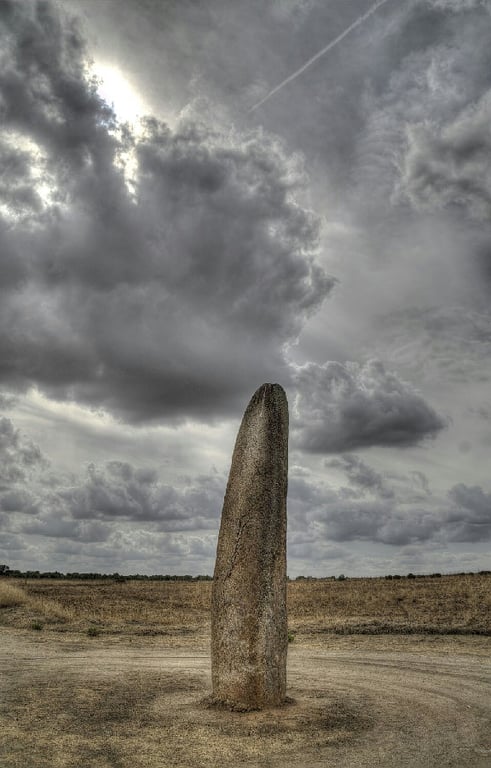
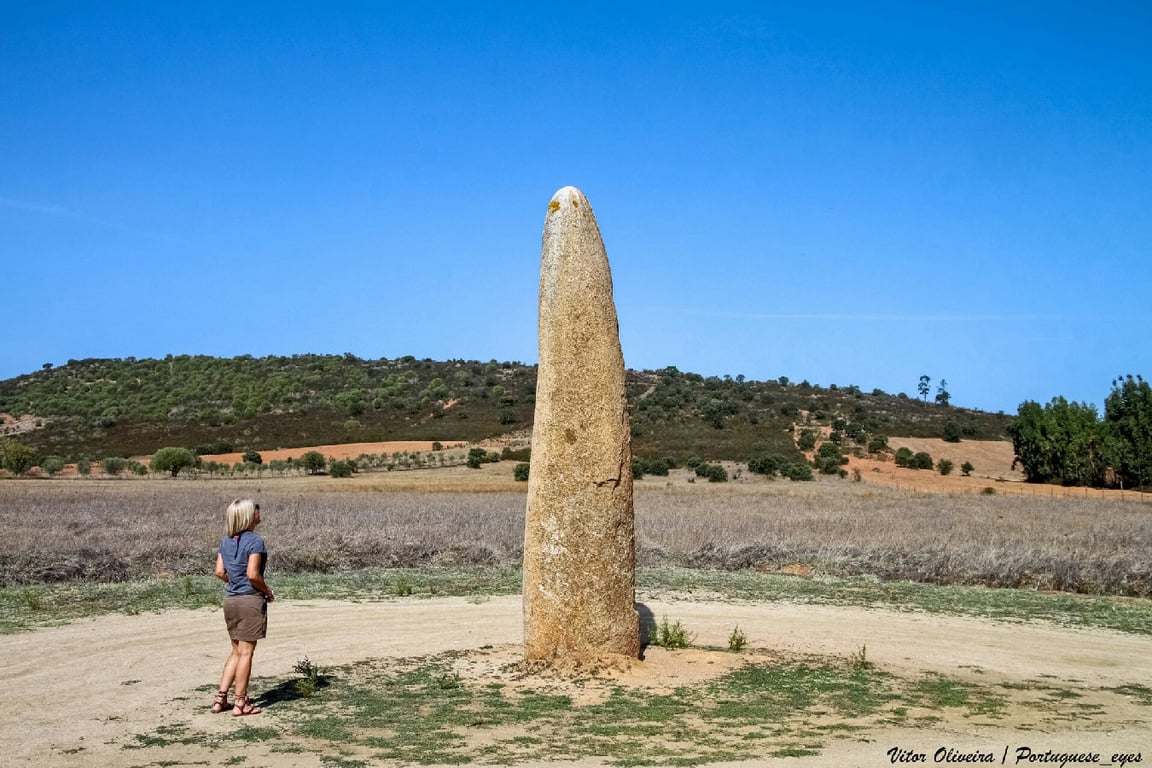
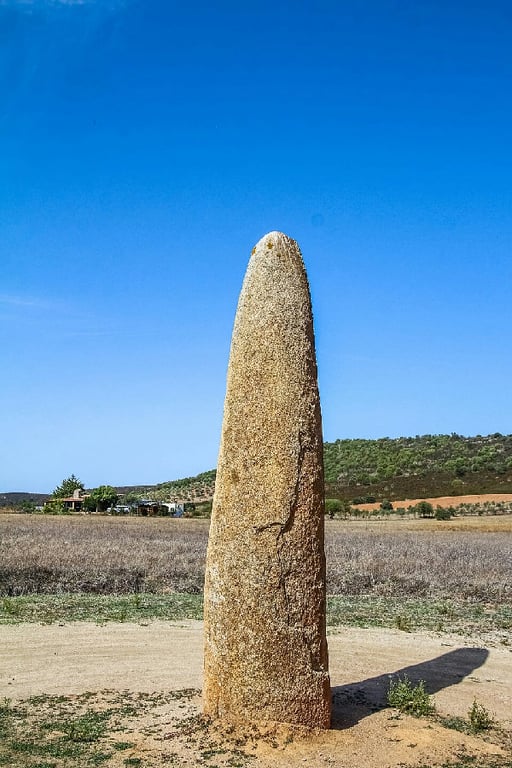
Standing in a lonely field some six kilometres north of the fortified village of Monsaraz, the Menir do Outeiro is a colossal granite finger pointing towards the sky. At 5.6 meters in height and weighing an estimated eight tonnes, it is one of the tallest and most impressive standing stones in the Iberian Peninsula. Quarried and erected between 4,000 and 3,000 BCE, this megalith is a powerful testament to the organizational prowess and spiritual beliefs of the Neolithic communities that first settled the vast, rolling plains of the Alentejo. Its sheer scale and stark solitude make it a profoundly evocative monument, connecting the modern visitor directly to a deep and enigmatic past.
The Granite Sentinel
Carved from a single block of local granite, the menhir has a classic, sub-conical shape, tapering towards the top. Its surface is rough and weathered, scarred by millennia of exposure to the elements, yet its form remains remarkably distinct. Its creators chose the stone and its location with care, placing it on a slight rise—'outeiro' means 'hillock' in Portuguese—that enhances its visibility across the landscape. The stone was not merely placed on the ground but set deep into the earth to ensure its stability, a feat of engineering that required immense collective effort. The choice of granite was also significant; it is a durable, almost eternal material, reflecting a desire to create a monument that would last forever. The surface of the stone, though largely unadorned, is not without interest. Close inspection reveals subtle engravings and markings, including a series of faint vertical lines and small circular depressions, or 'cup marks', whose exact meaning remains a subject of scholarly debate.
A Fertility Totem in Stone
The Menir do Outeiro is widely interpreted as a phallic monument, a powerful symbol of fertility and virility. This interpretation is strongly supported by the distinct hollow, approximately 30 centimetres in diameter, that has been carved into its summit. Archaeologists believe this feature was designed to represent a urethra, leaving little doubt as to the monument's symbolic function. In Neolithic societies, the fertility of the land, of livestock, and of the people themselves was a matter of survival and paramount importance. Monuments like this were likely central to rituals intended to ensure abundance and the continuation of the community. It may have served as a focal point for seasonal ceremonies, a place where offerings were made to earth gods or sky deities, its imposing form acting as a conduit between the human and divine realms, ensuring the life-giving forces of nature would continue to bless the surrounding lands.
Reading the Prehistoric Landscape
The menhir was not an isolated object. It was a key part of a complex and densely populated megalithic landscape around Monsaraz, which includes hundreds of other monuments such as dolmens (tombs) and cromlechs (stone circles). Its height would have made it a crucial landmark, a navigational aid, and a territorial marker for the people who lived here. It may have defined the boundary of a tribal land, a sacred precinct, or a gathering place for different clans. Some researchers suggest it could also have had an archaeoastronomical function, aligning with the sun, moon, or certain stars at significant times of the year, such as the solstices. As the sun cast its shadow across the ground, the menhir could have acted as a giant sundial, helping to track the seasons for planting and harvesting. It stands today as a silent yet eloquent reminder of the sophisticated worldview of its creators.
Whispers from the Granite Giant: The Other Side of Menir do Outeiro
Beyond the stark facts of its immense size and ancient origins, the Menir do Outeiro holds a deeper, more elusive story. While official records note its Neolithic construction, they fall silent on its true purpose and the energies it has witnessed over six millennia. To stand before it is to feel a connection not just to the past, but to a web of forgotten knowledge, cosmic alignments, and local whispers that cling to its weathered granite surface like the morning mist. This is not merely a stone; it is a silent narrator of forgotten histories and enduring mysteries.
A Battle Etched in Stone
Look closer at the menhir’s timeworn face, and you'll find more than natural erosion. Faintly carved into the granite are symbols that do not belong to its creators. A simple cross and a bishop's staff, almost lost to the ages, are the ghostly imprints of a much later era. Archaeologists interpret this as a classic act of Christianization, an attempt by later faiths to neutralize or co-opt the raw, pagan power of the site. This was no mere decoration; it was a spiritual superimposition. The menhir's overtly phallic form, a potent symbol of fertility and life force to its Neolithic builders, was likely seen as a threat to be tamed. These faint carvings represent a silent war of beliefs, fought across thousands of years on the battlefield of this single stone.
The Shepherd's Curse and the Midnight Shadow
The local lore surrounding the Menir do Outeiro is far richer than any guidebook suggests. Farmers in the region speak of the stone not as an inanimate object, but as a watchful guardian with a will of its own. It is said that livestock will not shelter near its base during a storm, as if sensing a strange energy field. One enduring tale speaks of its connection to the supernatural realm.
The Legend of the Enchanted Moura
A recurring figure in Portuguese folklore, the *Moura Encantada* (Enchanted Moorish Maiden) is often linked to the menhir. Legend holds that on the night of the summer solstice, a beautiful, ethereal woman appears from behind the stone, guarding a hidden treasure buried deep beneath its roots. She is a spirit bound to the land, and it is said she offers the treasure to any pure-hearted soul who can break her enchantment. Yet, no one has ever succeeded, and she remains a shimmering, sorrowful guardian of the monolith’s deepest secret.
Echoes of a Lost Science
While mainstream archaeology often settles on ceremonial or funerary purposes, more daring theories suggest the menhir was part of a forgotten technology. Its placement, composition, and orientation hint at a level of scientific understanding that defies our conventional view of the Neolithic mind.
The Telluric Current Hypothesis
The menhir is a massive piece of granite, a rock rich in quartz crystals. Proponents of earth energy theories suggest that such stones were not placed randomly. They were intentionally erected at nexuses of telluric (natural earth) currents, acting as massive acupuncture needles for the planet. The quartz within the granite, known for its piezoelectric properties, could theoretically interact with these energies, turning the menhir into a resonator or amplifier. Was this colossal stone a tool for harnessing natural forces, perhaps to enhance crop fertility or facilitate shamanic trance states?
A Celestial Timepiece
Its alignment with solar events is well-documented, but some researchers believe its purpose was far more complex. The Menir do Outeiro is a key point within the vast megalithic complex of Reguengos de Monsaraz. Its location may form a precise geometric relationship with other major sites, like the Almendres Cromlech, creating a sacred landscape map. This network could have tracked not just the sun and moon, but also the rising and setting of specific stars or constellations that held deep meaning for its builders—a celestial clock whose full workings we can no longer read.
Menir do Outeiro — photo gallery