Menir dos Almendres
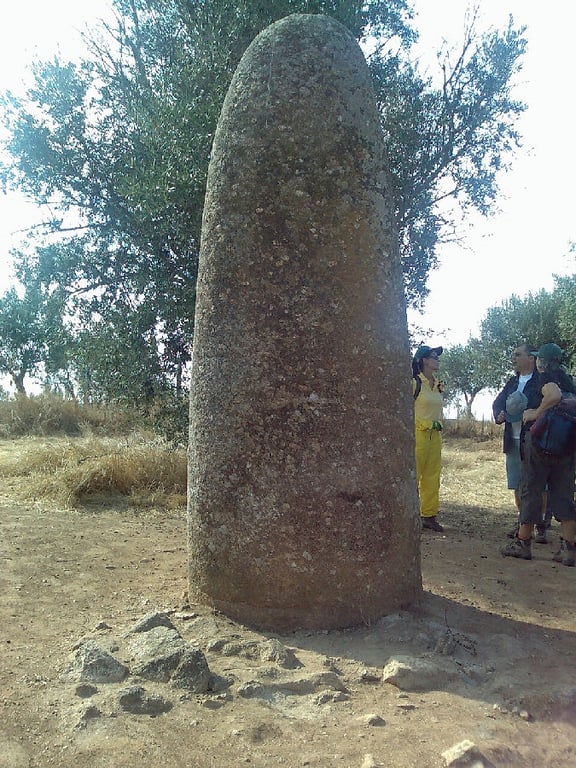
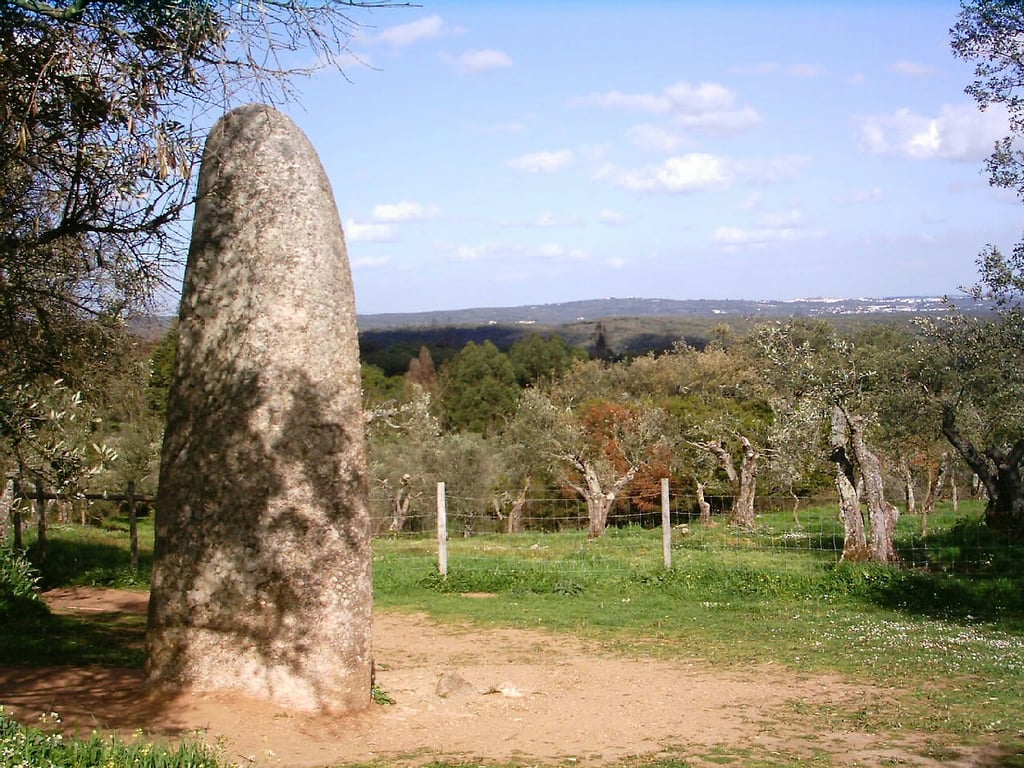
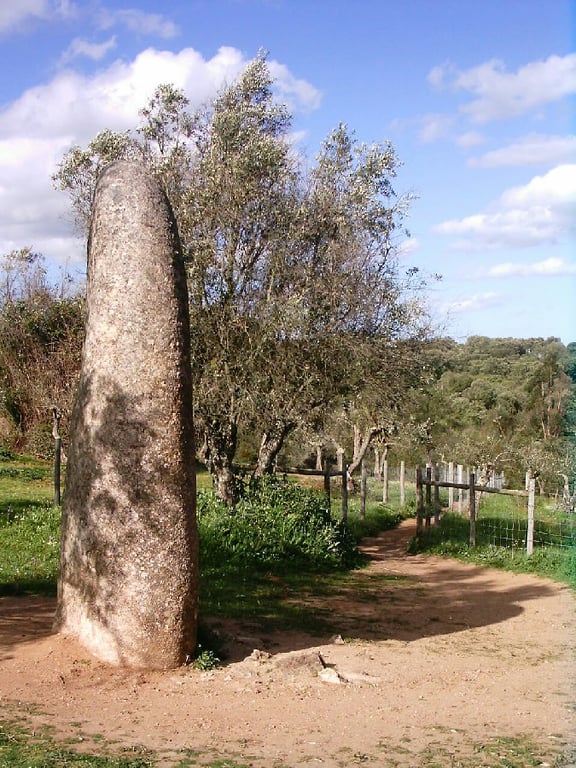
A solitary granite sentinel, this 4-metre tall menhir stands guard over the Alentejo landscape. It forms an astronomical alignment with the nearby Almendres Cromlech.
Menir dos Almendres
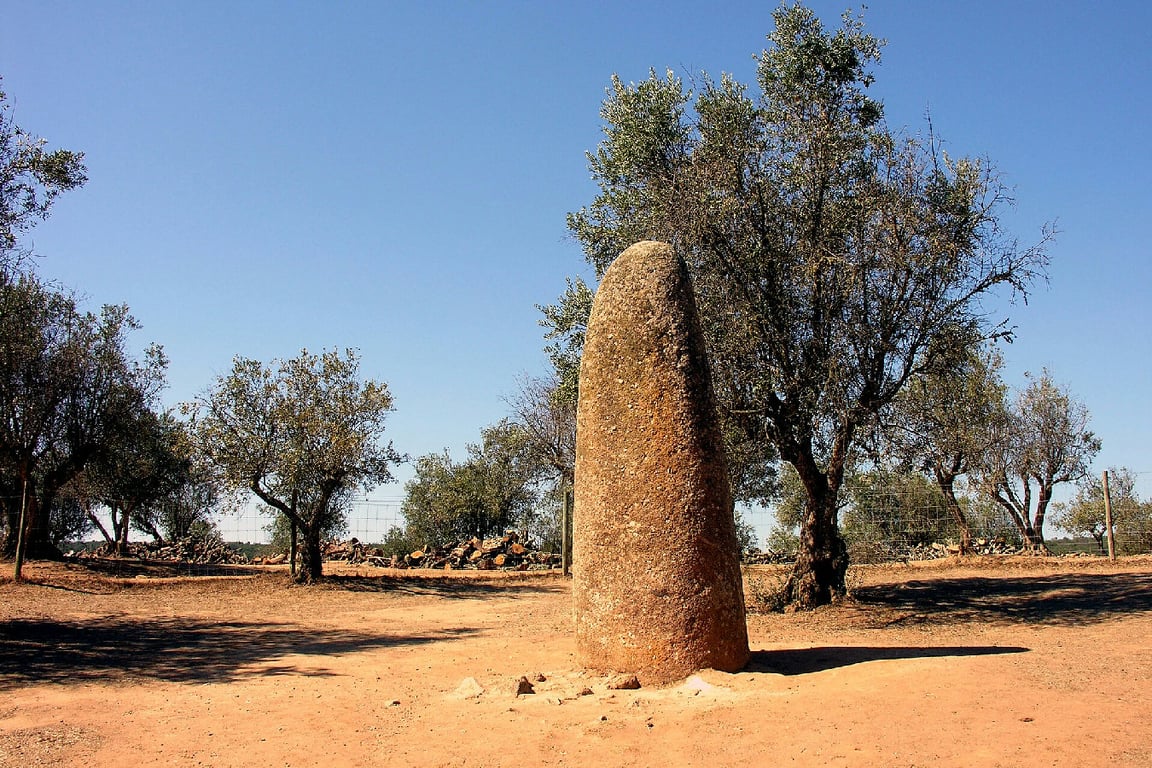
Standing as a solitary sentinel in the sun-drenched plains of the Alentejo, the Menir dos Almendres is a single, colossal monolith that commands attention. Located approximately 1.4 kilometres northeast of the famous Almendres Cromlech, this four-metre-high granite menhir serves as a crucial component of one of Iberia’s most significant megalithic landscapes. Re-erected in the mid-20th century after being discovered lying flat, its imposing presence against the open sky evokes a profound connection to the Neolithic communities who shaped this region over 6,000 years ago. Its careful placement suggests it was far more than a simple marker, playing a key role in the astronomical and ritualistic life of its builders.
The Watcher of the Solstice
The most compelling aspect of the Menir dos Almendres is its precise astronomical alignment with the main cromlech. From the centre of the Almendres Cromlech enclosure, the menhir marks the position of the sunrise on the winter solstice, the shortest day of the year. This deliberate positioning transforms the stone from a mere monument into a sophisticated calendrical instrument. It demonstrates a deep, generational knowledge of celestial cycles, allowing its creators to track the seasons, predict agricultural timings, and anchor their ceremonial calendar to the cosmos. This connection between the earth and the sky is a fundamental characteristic of megalithic architecture in the region, and the Menir dos Almendres is one of its most elegant and unambiguous examples.
The Bishop's Staff
Unlike many other menhirs, the Menir dos Almendres is not an unadorned stone. Near its apex, it bears a subtle but distinct engraving of a crosier, or a bishop's staff. This simple, curved symbol is a powerful one, often associated with pastoralism, leadership, and spiritual authority. Its inclusion suggests the menhir may have represented a deity, an ancestral figure, or a symbol of power and fertility for the surrounding community. The carving is best viewed in the raking light of early morning or late afternoon, when shadows reveal its form. This decorative element provides a rare glimpse into the symbolic world of the Neolithic people who quarried, transported, and erected this massive stone with rudimentary technology.
A Piece of a Larger Puzzle
The menhir cannot be fully understood in isolation. It is intrinsically linked to the Almendres Cromlech, a larger and more complex ceremonial site featuring nearly a hundred monoliths arranged in a double oval. The menhir acts as a foresight, a distant point of reference that gives the main circle its astronomical meaning. Together, they formed a sacred landscape, a vast outdoor temple where rituals, ceremonies, and communal gatherings were likely held. This network of sites, scattered throughout the Évora region, highlights a well-organized and technologically capable society with a rich spiritual life, forever etching their presence into the enduring granite of the Alentejo.
The Untold Secrets of Menir dos Almendres
Beyond the sun-baked soil of the Alentejo, the Menir dos Almendres is more than a four-metre granite monolith; it is an anchor point for forgotten cosmic narratives and whispered local legends. While its sheer size is impressive, its true mystery lies not in its physical form, but in the questions it poses about the beliefs of its Neolithic creators. It stands apart from its famous neighbour, the Almendres Cromlech, guarding secrets that mainstream archaeology often overlooks, inviting us to look past the stone and into the shadows of a deep, enigmatic past.
The Fallen Giant's Shadow
The menhir we see today is a modern reconstruction of an ancient vision. When rediscovered in the mid-20th century, it was not pointing towards the heavens but was found lying flat, dormant and integrated with the earth. Its re-erection was an act of preservation, but it raises a profound, unsettling question: did we get it right? Scholars debate whether its current vertical position and orientation perfectly match its original placement. This act of "awakening" the fallen giant may have inadvertently altered its sacred function, shifting its relationship with the sun, moon, and surrounding landscape. What was once a horizontal marker, perhaps aligned with a telluric current or a specific point on the horizon, is now a vertical axis, forever changing the story it was meant to tell.
A Celestial Pointer or a Fertility God?
The purpose of this solitary stone is a subject of intense esoteric and archaeological debate. To some, it is a colossal gnomon, the hand of a giant sundial used in conjunction with the Almendres Cromlech to mark solstices or equinoxes. This theory positions it as a precise astronomical instrument, a key piece in a landscape-sized celestial clock. Yet, another compelling interpretation views the menhir through a more primal lens. Its overtly phallic shape is hard to ignore, suggesting it was a powerful symbol of fertility and masculine energy, a focus for rituals intended to ensure the fecundity of the land, the livestock, and the tribe itself.
The Serpent's Crook
Etched near the top of the monolith is a curious engraving often described as a crosier, or a shepherd’s crook. While this suggests a symbol of leadership or guidance, a more mystical interpretation sees the form of a serpent head. In many ancient belief systems, the serpent represented rebirth, cyclical knowledge, and chthonic power rising from the underworld. This carving could transform the menhir from a mere marker into a sacred effigy, a conduit for earth energies, or a representation of a deity whose name is long lost to time.
The Lonely Oracle of the Cromlech
Its deliberate placement, over a kilometre away from the main Almendres Cromlech, is not an accident of isolation but a statement of connection. From the centre of the cromlech, the Menir dos Almendres aligns with the sunrise on the winter solstice. It is not a solitary sentinel but an oracle, a distant foresight that announces the sun's rebirth each year. This positioning transforms the entire landscape into a single, interconnected ceremonial space. The menhir acts as the trigger, the distant herald that activates the sacred purpose of the stone circle, proving that its solitude is merely an illusion—it has been watching and waiting for its celestial partner all along.
Menir dos Almendres — photo gallery