Cromeleque Portela dos Mogos
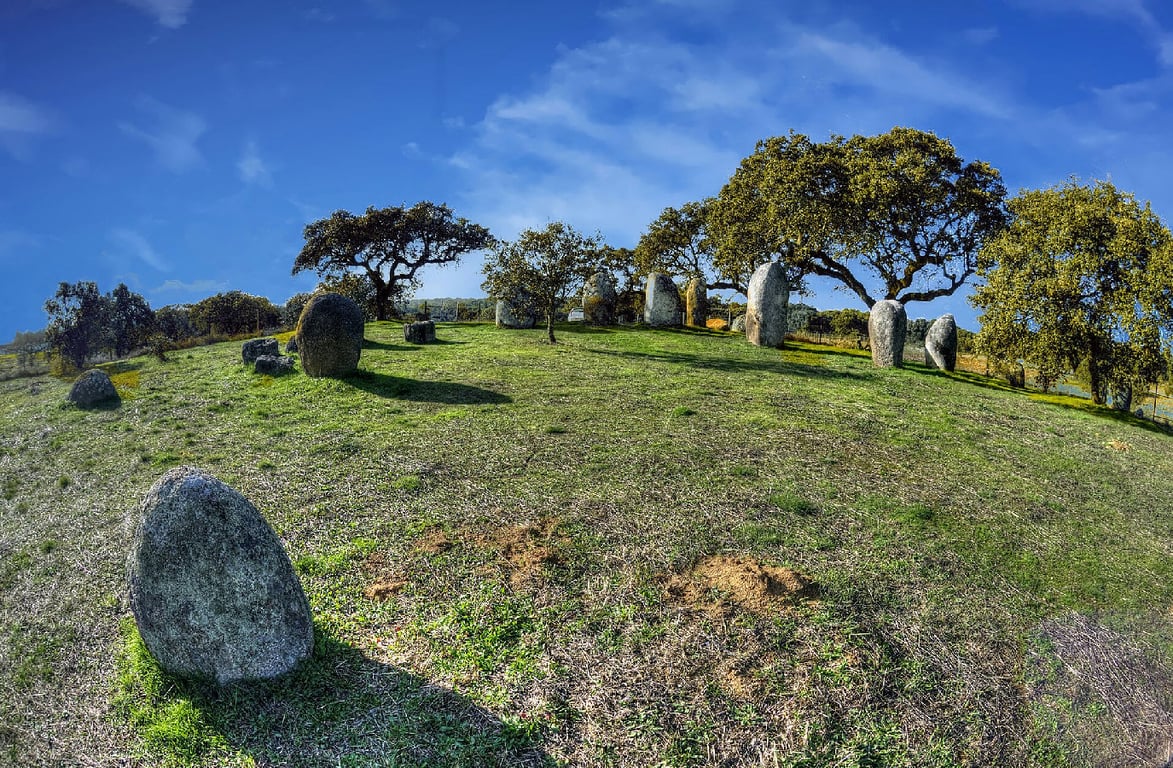
A classic circular cromlech, once centered on a great menhir. This monument forms a megalithic duo with the nearby rectangular enclosure of Vale Maria do Meio.
Cromeleque Portela dos Mogos
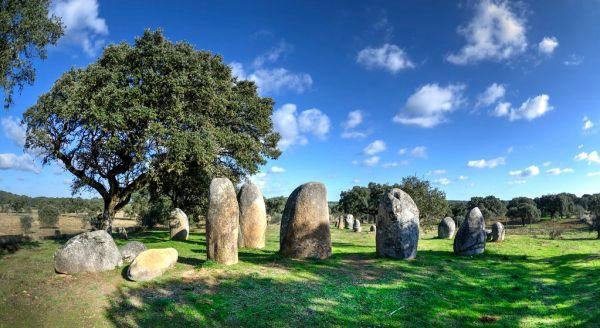
Adjacent to the unusual rectangular enclosure of Vale Maria do Meio, the Cromeleque Portela dos Mogos offers a more classic, though equally compelling, vision of Neolithic ritual architecture. This monument, located in the rich megalithic landscape north of Évora, was originally constructed as a circular arrangement of standing stones. Though many of its monoliths are now fallen or partially buried, the site's most dramatic feature is a colossal central menhir, now lying on its side like a sleeping giant. Its close association with its rectangular neighbour suggests they formed a unified ritual complex, a sacred space where different architectural forms served distinct, yet complementary, purposes for the ancient communities of the Alentejo.
The Fallen Heart
The focal point of Portela dos Mogos is undoubtedly its great central menhir. Measuring over seven metres in length, it would have been a truly monumental pillar when it stood upright, dominating the surrounding circle of smaller stones and the wider landscape. The effort required to shape, transport, and erect such a massive stone speaks to its profound importance. Central menhirs in cromlechs are often interpreted as phallic symbols of fertility, representations of a powerful deity, or ancestral markers that served as the nucleus of ritual activity. Although it now rests on the ground, its immense scale continues to impress, providing a tangible link to the ambition and spiritual focus of its Neolithic builders.
A Fading Circle
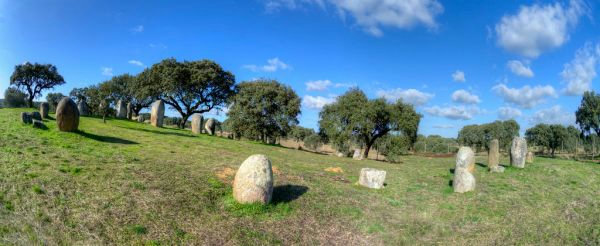
Surrounding the fallen giant are the remnants of the outer ring of stones. While the exact number of original menhirs is uncertain due to millennia of disruption, the surviving stones allow archaeologists to trace the monument's circular footprint. The circle, a universal symbol of unity, eternity, and the cosmos, defined the sacred space, separating it from the mundane world outside. It is easy to imagine ceremonies taking place within this boundary, focused on the powerful central stone. The partial preservation of the site adds to its evocative nature, leaving the visitor to ponder the forces—both natural and human—that have altered this sacred enclosure over time.
A Tale of Two Sanctuaries
The true significance of Portela dos Mogos is revealed in its relationship with the nearby Cromeleque de Vale Maria do Meio. The juxtaposition of a circular cromlech with a large central menhir and a processional rectangular enclosure is unique in the region. This pairing strongly implies a deliberate design, creating a larger sacred complex with multiple functional areas. Perhaps the path of Vale Maria do Meio led towards the circle of Portela dos Mogos, creating a ritual journey. Alternatively, the two sites may have catered to different rites or different social groups. Together, they represent a sophisticated expression of Neolithic cosmology, a landscape purposefully engineered to align with both the heavens and the belief systems of the people.
The Whispering Stones of Portela dos Mogos
Beyond the official archaeological records and dry academic papers lies the true enigma of Cromeleque Portela dos Mogos. While its colossal central menhir commands attention, the site's deepest secrets are not found in what remains standing, but in the silent questions posed by its fallen stones and its relationship with the starkly geometric landscape it inhabits. This is not just a ruin of a stone circle; it is a fragment of a forgotten cosmic dialogue, a place where conventional archaeology falls silent and whispers of the unknown begin.
A Sacred Geometry Schism?
The most profound and overlooked mystery of Portela dos Mogos is its immediate proximity to the Vale Maria do Meio enclosure. While the cromelech adheres to the classic, universal form of the circle—symbolizing eternity, the sun, and the sky—its neighbor is a rigid, almost unnervingly precise rectangle. This is a profound anomaly in Iberian megalithic design. Scholars rarely speculate on the cultural implications of such a jarring juxtaposition. Were these sites built by two different cultures with conflicting cosmologies, forced to coexist? Or do they represent a single, more complex belief system, a duality of order and nature, terrestrial and celestial, life and death, intentionally placed in opposition?
The Anomaly of the Right Angle
One fringe theory suggests the rectangular enclosure was not for ritual in the same way as the circle. Instead, it may have been a "profane" space for the living, a demarcated settlement or gathering place, while the cromelech was the "sacred" space for the dead or the gods. This creates a conceptual map of the Neolithic world, with the circle representing the chaotic, cyclical nature of the spirit world and the rectangle representing the ordered, structured world of humanity. The two sites, seen together, form a single, sprawling philosophical statement written upon the earth itself.
The Burden of the Sleeping Mogos
Local folklore, though fragmented and often dismissed, offers another lens through which to view the site. The name "Mogos" is itself a puzzle, with some older residents claiming it refers to ancient, powerful beings who were turned to stone. The legend speaks of a pact made with the earth, where these giant guardians, led by the colossal central menhir, vowed to stand watch over a hidden spring of immense power. The tale claims that when humanity forgot the proper rituals, the pact was broken. The earth trembled, not in anger, but in sorrow, and most of the Mogos fell into a deep slumber, their stone forms collapsing where they stood, waiting for a time when the old ways are remembered and they can be awakened once more.
Harnessing Earth's Invisible Currents
Moving beyond folklore, some researchers in the realm of archaeoacoustics and earth energies propose a more controversial function for the cromelech. The specific type of granite used for the monoliths, rich in quartz, has led to speculation that the circle was not merely a celestial calendar but a resonator. The theory posits that the stones were strategically placed along telluric currents—invisible lines of telluric energy—to amplify them. The great central menhir would have acted as a primary antenna, drawing in energy and sound, which would then be focused and modulated by the surrounding circle for use in healing rituals, altered states of consciousness, or even communication with unseen forces. In this view, the fallen stones are not just a sign of decay, but of a complex machine that has been switched off.
Cromeleque Portela dos Mogos — photo gallery