Sanxingdui
Enigmatic Bronze Age civilization, completely absent from Chinese historical records, revealed colossal bronze masks and unique figures. Discovered accidentally in 1986, it showcases a culture distinct from Central Plains dynasties.
Sanxingdui: A Lost Civilization Emerges
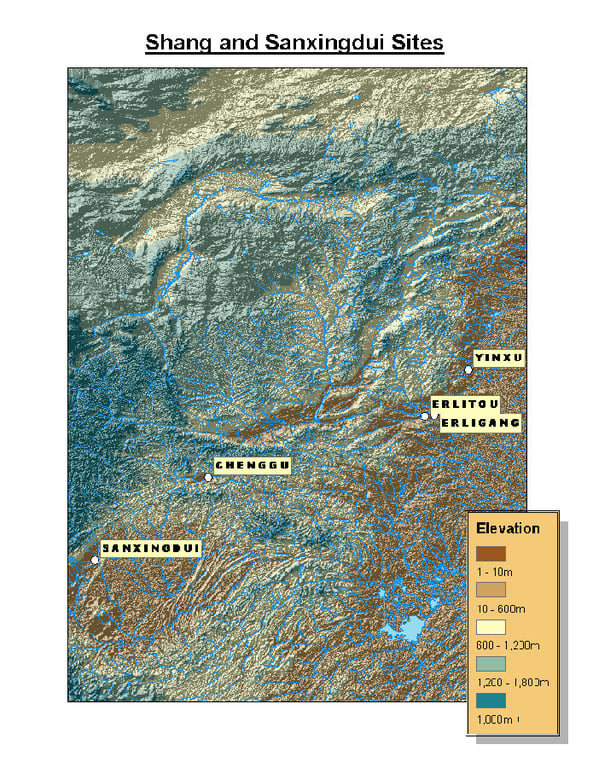
Sanxingdui, located in Guanghan, Sichuan Province, stands as one of China's most profound archaeological mysteries. This extraordinary site represents a highly developed Bronze Age culture that flourished between approximately 1700 and 1100 BC. What makes Sanxingdui particularly enigmatic is its complete absence from traditional Chinese historical accounts, suggesting a civilization that existed largely independently of the documented dynasties of the Central Plains.
The Accidental Revelation
The discovery of Sanxingdui was serendipitous. In 1986, brick factory workers accidentally unearthed an ancient sacrificial pit containing thousands of artifacts. This initial find quickly led to further excavations, revealing two major pits filled with astonishing objects unlike anything seen before in Chinese archaeology. The sheer volume and unique style of these artifacts immediately challenged prevailing notions about the uniformity of early Chinese civilization.
Bronze Age Masterpieces
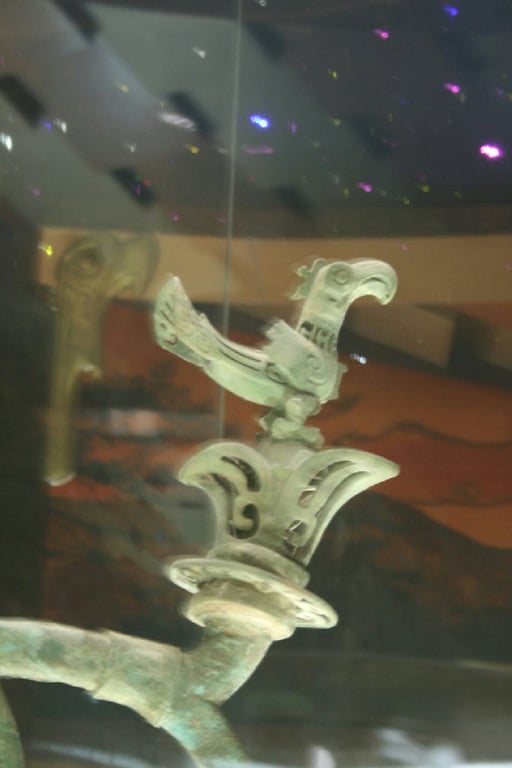
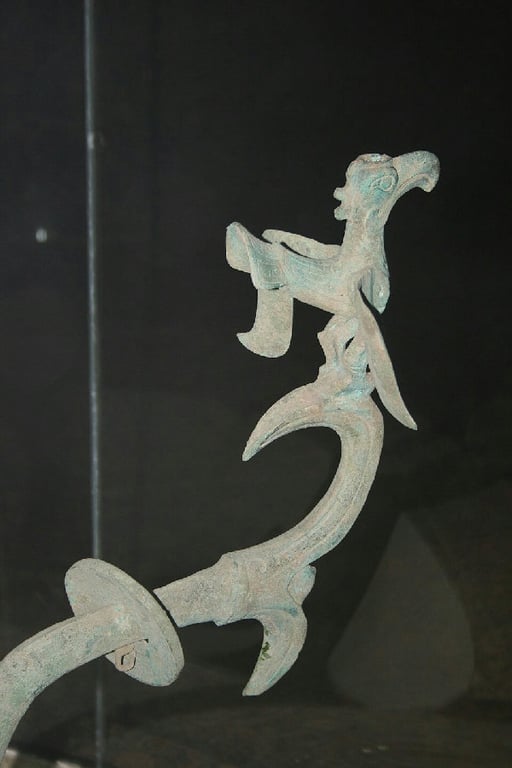
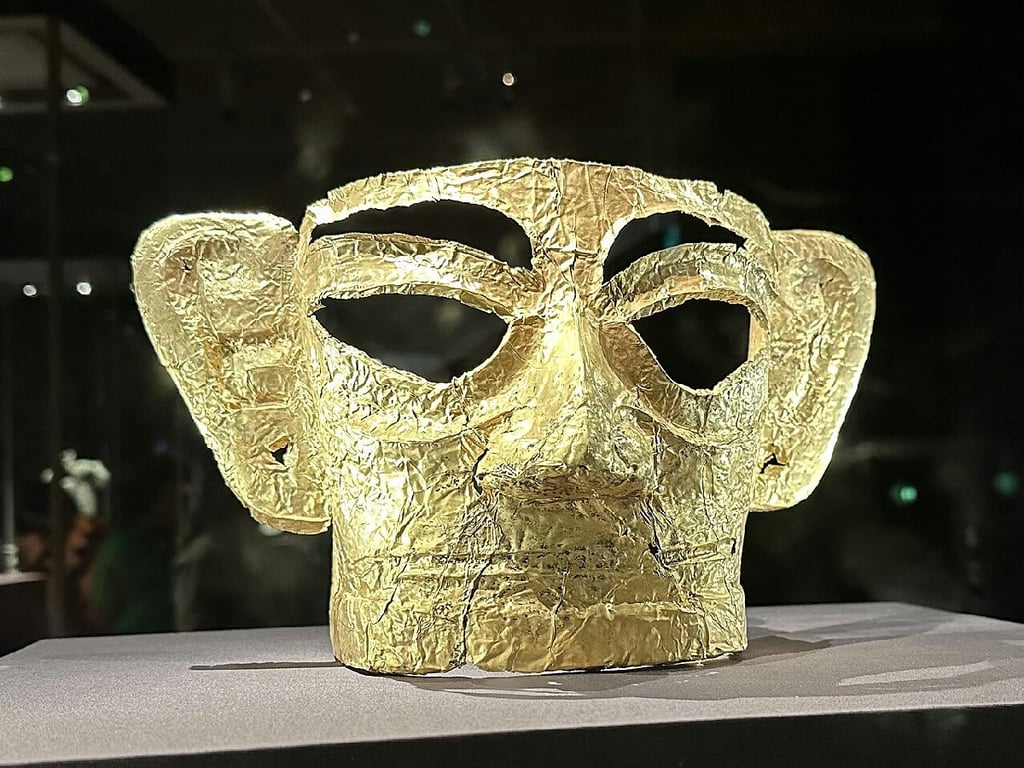
The most iconic finds from Sanxingdui are its monumental bronze objects. Among them are colossal masks, some over a meter in height, with exaggerated features, protruding eyes, and large ears. These masks, often adorned with gold foil, are thought to represent deities or ancestral figures, possibly used in elaborate rituals. Equally striking are the towering bronze sacred trees, one reaching nearly four meters, intricately decorated with birds, dragons, and fruits, believed to symbolize a connection between the earthly and celestial realms.
Figures from Another World
Beyond the masks and trees, Sanxingdui yielded numerous bronze human figures, some life-sized, with slender bodies, long robes, and distinctive facial features that have been described as 'alien-looking.' These figures often hold ceremonial objects or stand in postures suggesting ritualistic roles. The craftsmanship involved in casting such large and intricate bronzes indicates a sophisticated metallurgical technology and a highly organized society capable of mobilizing significant resources and labor.
A Distinct Cultural Identity
The artifacts of Sanxingdui bear little resemblance to contemporary Shang or Zhou dynasty bronzes from other parts of China. This distinctiveness points to a unique cultural and artistic tradition, potentially with its own religious beliefs and social structures. The site also revealed jade artifacts, pottery, and intricately carved ivory tusks, further diversifying our understanding of this forgotten people. While the script has not been found, the symbols and iconography on the bronzes hint at a rich symbolic language.
Unanswered Questions
Despite decades of study, many questions about Sanxingdui remain unanswered. Who were these people? What language did they speak? Why did their civilization seemingly vanish? And what prompted them to ritually bury such a vast collection of precious objects? Archaeological work continues, slowly piecing together the narrative of this extraordinary lost culture, offering invaluable insights into the diverse tapestry of ancient Chinese civilizations and challenging the traditional, often monolithic, view of early Chinese history.
Sanxingdui: Beyond the Bronze Veil
While the world marvels at Sanxingdui’s monumental bronze figures and enigmatic masks, the true depth of its mystery lies not just in what was found, but in the questions that persist. This ancient site, often described as a "lost civilization," harbors secrets that challenge conventional archaeological narratives, inviting us to peer past the well-known artifacts into a realm of obscure facts, forgotten legends, and radical theories that stir the imagination. For the open-minded seeker, Sanxingdui offers more than history; it offers an unsolved puzzle echoing through millennia.The Deliberate Oblivion: Sanxingdui's Ritual End?
One of Sanxingdui's most perplexing "facts" is not its existence, but its sudden, ritualistic disappearance. Unlike civilizations that fade through natural decline or conquest, evidence at Sanxingdui points to a deliberate, methodical termination. The famous sacrificial pits, brimming with shattered bronzes, deliberately broken jade, and burnt ivory, suggest a profound act of ritual destruction and burial around 1100 BC. This wasn't merely abandonment; it was a conscious sealing of an entire culture. Scholars debate whether this was a grand offering to appease deities, a response to an unknown cataclysm, or a symbolic act of renewal. The complete lack of evidence for invasion or widespread violence makes this self-imposed oblivion a far more intriguing, and unsettling, mystery than simple collapse.
The Vertical Gaze and Celestial Whispers: Local Lore
Beyond academic texts, local legends offer a different lens into Sanxingdui's past. The most striking artifact, the colossal bronze mask with its dramatically protruding, "vertical" eyes, is often linked to the ancient mythological king Cancong. Folk tales describe Cancong as having eyes that pierced through the heavens, a divine ancestor who taught the Shu people sericulture and irrigation. This isn't just a historical figure; he’s a deity, a culture hero whose extraordinary vision might be reflected in the mask's otherworldly features. Furthermore, the very name "Sanxingdui" translates to "Three Stars Mound," igniting whispers among locals and some theorists of a connection to a specific celestial alignment or a lost constellation, perhaps even mirroring the three prominent mounds that define the site itself – a terrestrial reflection of a cosmic order. Was the site a powerful observatory, or a sacred landscape aligned with the heavens?
The Eye That Saw Beyond Worlds
The "vertical-eyed" mask isn't merely an artistic choice; it resonates with a deeper cosmological significance. Local lore suggests these eyes weren't just for sight but for perceiving other dimensions, for communion with the divine. This takes the artifact beyond mere representation, transforming it into a conduit for ancient spiritual beliefs that are largely unrecorded elsewhere.
A World Apart: The Unconventional Aesthetic Debate
The artistic style of Sanxingdui is so profoundly distinct from contemporary Shang and Zhou dynasties that it sparks intense debate. The slender, almost alien-like human figures, the strangely elongated faces, the exaggerated features, and the lack of chariots or obvious weaponry in the pits, all point to a culture that developed largely in isolation, or perhaps under entirely different influences. Why did the Sanxingdui artists eschew the common motifs and forms of other Chinese cultures? Was it a deliberate rejection, a unique indigenous development, or evidence of undocumented contact with cultures far beyond the perceived boundaries of ancient China? This radical divergence challenges the very notion of a monolithic "Chinese civilization" during the Bronze Age, suggesting a dynamic, multi-faceted cultural landscape far more complex than traditional histories portray.
Elephantine Echoes: Uncharted Trade Routes?
Among the treasures unearthed at Sanxingdui are staggering quantities of elephant tusks – some weighing over 100 kilograms each. The presence of such a vast ivory hoard raises a crucial, lesser-discussed question: where did they come from? While elephants did exist in ancient China, the sheer scale of the ivory suggests either an unprecedented local population or, more intriguingly, extensive, long-distance trade networks. Did the Sanxingdui people have connections extending to Southeast Asia, India, or even further afield? If so, it implies a level of ancient global interaction and sophisticated trade routes that drastically reconfigures our understanding of Bronze Age commerce and cultural exchange, hinting at a Sanxingdui that was not isolated, but a node in a forgotten international web.
Sanxingdui — photo gallery