Banpo Neolithic Village
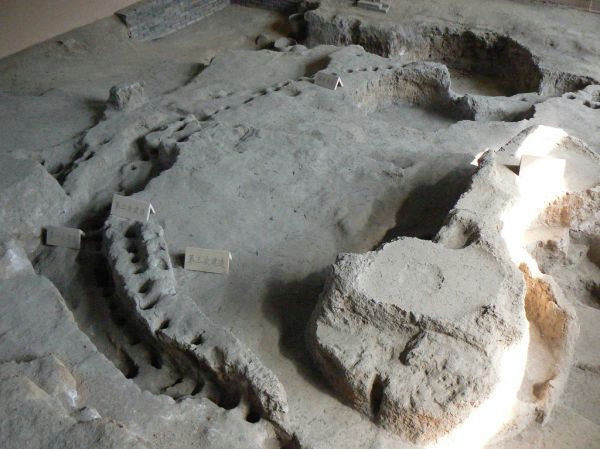
A remarkably preserved Yangshao culture settlement from around 4500 BC, featuring excavated dwellings, burial grounds, and in-situ child jar-burials. It stands as one of Asia's best-preserved Neolithic villages.
Banpo Neolithic Village: Echoes of Ancient Life
The Banpo Neolithic Village, situated near Xi'an in Shaanxi Province, China, offers a rare and remarkably preserved window into life during the Yangshao culture. Dating back approximately 6,000 to 6,700 years (around 4500 BC), Banpo is one of the most significant and well-preserved examples of a Neolithic settlement in Asia, providing invaluable insights into the early agricultural societies of ancient China.
Discovery and Excavation
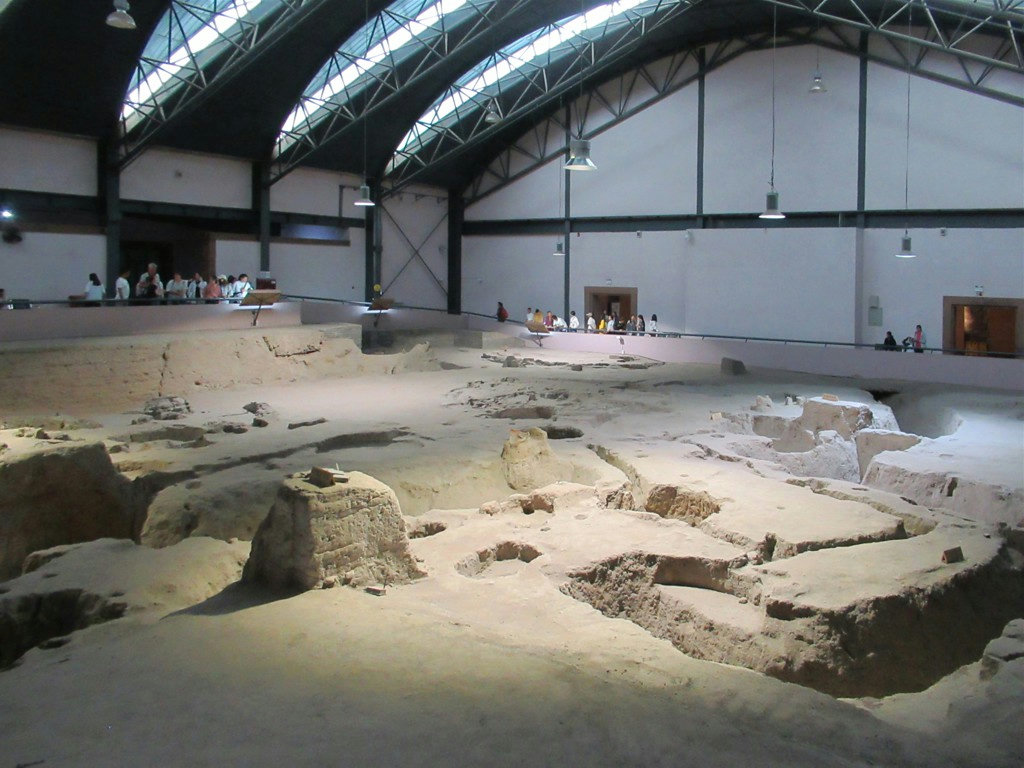
Discovered in 1953, the Banpo site underwent extensive archaeological excavation, revealing a complete village layout. The excavations uncovered foundations of numerous dwellings, storage pits, kilns, and communal burial grounds. What makes Banpo particularly compelling is that many of these features are still visible *in situ*, allowing visitors to walk through the reconstructed village and observe the original archaeological remains, gaining a tangible connection to its ancient inhabitants.
Life in a Matrilineal Society
The Banpo village was organized in a distinctive manner, characteristic of early agricultural communities. Evidence suggests a matrilineal clan society, where women played a central role in both daily life and social structure. The dwellings were typically round or square, semi-subterranean structures with wooden frames and thatched roofs, designed to offer protection from the elements. A large, communal longhouse likely served as a meeting place or a residence for the clan chief.
Farming and Craftsmanship
The inhabitants of Banpo were primarily farmers, cultivating millet as their staple crop. They also engaged in hunting, fishing, and gathering to supplement their diet. The discovery of numerous pottery shards and intact vessels highlights their advanced craftsmanship. Banpo pottery, distinctive for its red earthenware adorned with black painted geometric designs, human faces, and fish motifs, is a hallmark of the Yangshao culture. Tools made from stone and bone for farming, hunting, and textile production further illustrate their daily activities and technological capabilities.
Unique Burial Practices
One of the most poignant features of Banpo is its burial practices. Adults were typically buried in communal cemeteries outside the main living area. However, infants and young children were often interred in large pottery jars, or 'jar-burials,' placed within the village itself, sometimes even beneath the floors of dwellings. These jar-burials, some still visible today, offer a tender glimpse into the spiritual beliefs and emotional connections of the Banpo people, perhaps symbolizing a desire to keep the youngest members of the community close even in death.
An Enduring Legacy
Today, the Banpo Neolithic Village is preserved as a museum, where visitors can explore the excavated areas, reconstructed dwellings, and a comprehensive exhibition hall showcasing artifacts. The site provides a profound educational experience, illuminating the ingenuity and daily rhythms of Neolithic life in China. Banpo stands as a crucial archaeological landmark, helping us understand the foundational developments of Chinese civilization and the enduring human quest for community and sustenance.
The Silent Riddles of Banpo Village
Beyond the glass cases and reconstructed huts of the Banpo Museum lies a far more enigmatic story than most visitors are told. The official narrative speaks of a harmonious, matriarchal society of farmers and potters. But peel back the layers of accepted history, and you find a world of cryptic symbols, strange rituals, and a sudden, haunting disappearance that conventional archaeology struggles to fully explain. The true mysteries of Banpo are not in what we know, but in the unsettling questions that remain etched into its very soil.
The Cryptic Scratches on Clay
While the iconic fish and human-face motifs on Banpo pottery are famous, the far more perplexing markings are often overlooked. On thousands of pottery shards, archaeologists discovered over 113 distinct, incised symbols—simple lines, crosses, and arrow-like shapes. Textbooks dismiss them as mere "owner's marks" or decorative flourishes. Yet, a persistent minority of scholars and independent researchers see something more profound. They argue these are not random doodles but a systematic, proto-writing system, a lost symbolic language predating oracle bone script by millennia. Could these marks be ritualistic incantations, astronomical observations, or a complex clan identification system whose key is lost to time? The symbols remain stubbornly undeciphered, a silent testament to a forgotten intellectual world.
A Society Severed by a Ditch
A massive defensive ditch, nearly 20 feet wide and deep, encircled the main living area of Banpo. The standard explanation is simple: protection from wild animals. But this theory fails to satisfy many. The ditch was an immense undertaking for a small community, suggesting a more pressing threat. Some theorists propose a more radical idea: the ditch wasn't for keeping things out, but for keeping people in—or, more accurately, for separating them. Could it have been a stark boundary between a ruling shamanistic class and the common populace? Or perhaps it was a ritualistic barrier, a symbolic line separating the sacred space of the living from the spirit-haunted wilderness beyond, a division far more psychological than physical.
Whispers from the Burial Urns
Perhaps the most disturbing practice at Banpo was the burial of children. Infants and young children were not placed in the communal cemetery with adults but were interred in large clay urns, which were then buried just outside their family homes. Each burial urn had a small hole deliberately punched in the top.
The Spirit's Chimney
Archaeologists soberly suggest the hole was to allow the child's spirit to escape and rejoin the living. However, local folklore from the Xi'an region offers a darker, more poignant interpretation. One tale speaks of a belief that a child's ghost, unable to find its way to the afterlife, would haunt its own home, bringing misfortune. The urn was a vessel to contain the restless spirit, while the hole acted as a "spirit's chimney," allowing the family to leave offerings of smoke and prayers to appease the ghost and guide it peacefully away from the hearth. This transforms the practice from a simple burial into a complex and fearful negotiation with the spirit world.
When the River Spirits Turned
After flourishing for centuries, the Banpo village was abruptly abandoned. The common theories point to soil exhaustion or a shift in the Wei River's course. But these practical explanations don't capture the spiritual dimension of such an exodus. The people of Banpo revered the river; its fish were their sustenance and a central part of their cosmology, as seen in their art. A more provocative theory suggests the abandonment was a ritual act. Perhaps a series of catastrophic floods or devastating droughts were interpreted not as natural events, but as a sign that the local river spirits had turned against them. The entire community may have fled, not just for survival, but to escape a perceived curse, leaving their homes intact as a final, desperate offering to the angered gods of the water.
Banpo Neolithic Village — photo gallery