Sanguanmiao Han Dynasty Tombs
A vivid glimpse into China's past, hidden beneath a pond for centuries.
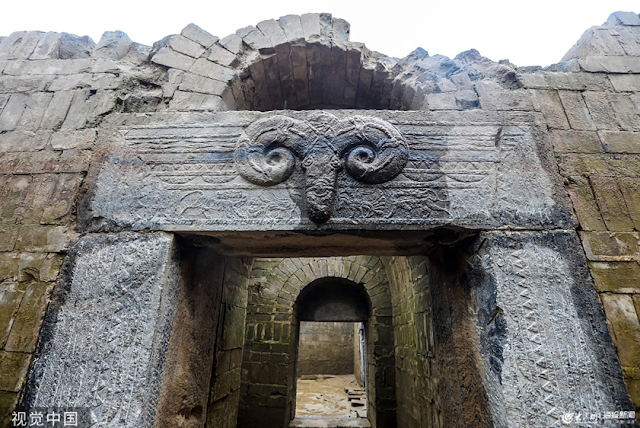
In late 2018, a routine pond-dredging operation in Jiyang District, Jinan, the capital of Shandong Province, China, led to an extraordinary archaeological discovery: three ancient tombs from the Han Dynasty (206 B.C.–220 A.D.). Unearthed by Jinan’s Institute of Archaeology, these tombs, adorned with delicate stone reliefs, offer a vivid glimpse into the cultural and artistic richness of one of China’s most formative eras.
Following nearly four months of meticulous excavation, archaeologists uncovered nearly 60 stone reliefs and over 90 portraits, each intricately carved and remarkably well-preserved. These artworks depict scenes of daily life, mythological narratives, and anthropomorphic figures, reflecting the Han Dynasty’s sophisticated artistry and spiritual worldview. The reliefs provide invaluable insights into the era’s social customs, religious beliefs, and artistic conventions, showcasing the Han people’s ability to blend practical and symbolic elements in their burial practices.
A distinctive feature of the tombs is the recurring motif of ram heads carved in bas-relief. This symbol, common in Han Dynasty tombs across Shandong, also appears in global mythological traditions, suggesting a shared cultural or spiritual significance. The ram, often associated with strength and fertility, may hint at the tomb occupants’ status or beliefs about the afterlife, though further research is needed to decode its precise meaning. This motif’s presence underscores the interconnectedness of ancient symbolic languages across regions.
The tombs’ submersion beneath a pond highlights a fascinating aspect of Chinese archaeology. Waterlogged environments, like those concealing the Longyou Caves, often preserve artifacts by limiting exposure to air and decay. The Jiyang discovery exemplifies how unassuming landscapes can hide extraordinary historical treasures, revealed only through serendipitous events like dredging. The pond’s role as a natural preservative ensured the reliefs’ intricate details remained intact, offering a rare opportunity to study Han Dynasty craftsmanship.
As one of the largest double-passage tomb complexes with stone reliefs found in Jinan, measuring approximately 20 meters long and 15 meters wide, the site underscores the era’s architectural ambition. These tombs enrich our understanding of Han burial practices, reflecting a society that valued elaborate memorials to honor the deceased. Ongoing research may further illuminate the tombs’ cultural context and their place within ancient China’s broader artistic and spiritual traditions. This discovery invites reflection on the enduring legacy of civilizations, preserved beneath the earth, waiting to reveal their stories to future generations. The Jiyang tombs’ submersion under a pond exemplifies how waterlogged environments can preserve ancient artifacts. Unlike terrestrial sites prone to decay, water creates anaerobic conditions, slowing deterioration. This phenomenon, seen in sites like China’s Jingdezhen kilns, where submerged porcelain survived centuries, protected the Jiyang tombs’ 60 stone reliefs, preserving intricate carvings of daily life and mythology. Uniquely, the pond’s silt likely stabilized the tombs’ structure, preventing collapse. Some scholars suggest ancient builders selected water-adjacent sites for spiritual reasons, believing water connected the living to the afterlife. This practice, evident in Han Dynasty hydraulic engineering, hints at deliberate site selection, making Jiyang a case study in how natural elements safeguard history.
Ram Head Motifs: A Universal Symbol The tombs’ bas-relief ram heads, a hallmark of Shandong’s Han tombs, carry global resonance. Unlike their local role as symbols of prosperity or celestial guardianship, ram motifs appear in distant cultures, suggesting shared symbolic traditions. In ancient Egypt, the ram-headed god Amun represented creative force, while Scythian art featured rams as symbols of power. In Mesoamerica, bighorn sheep motifs adorned ceremonial sites, possibly denoting leadership. These parallels raise questions about cultural diffusion or universal archetypes. Unconventionally, the Jiyang rams may reflect a lost cosmological narrative, potentially linking to ancient star cults, as rams were associated with Aries in early zodiacs. Their prominence in tombs suggests a protective role, guiding souls in the afterlife, a belief echoed in Indo-European mythologies.
The Jiyang tombs’ preservation under water and their ram motifs reveal a dual narrative of natural conservation and cultural interconnectedness. These findings underscore the ingenuity of ancient societies in preserving their legacy and invite further study into how symbols like the ram transcended regions, weaving a global tapestry of meaning that continues to captivate archaeologists and historians.
Following nearly four months of meticulous excavation, archaeologists uncovered nearly 60 stone reliefs and over 90 portraits, each intricately carved and remarkably well-preserved. These artworks depict scenes of daily life, mythological narratives, and anthropomorphic figures, reflecting the Han Dynasty’s sophisticated artistry and spiritual worldview. The reliefs provide invaluable insights into the era’s social customs, religious beliefs, and artistic conventions, showcasing the Han people’s ability to blend practical and symbolic elements in their burial practices.
A distinctive feature of the tombs is the recurring motif of ram heads carved in bas-relief. This symbol, common in Han Dynasty tombs across Shandong, also appears in global mythological traditions, suggesting a shared cultural or spiritual significance. The ram, often associated with strength and fertility, may hint at the tomb occupants’ status or beliefs about the afterlife, though further research is needed to decode its precise meaning. This motif’s presence underscores the interconnectedness of ancient symbolic languages across regions.
The tombs’ submersion beneath a pond highlights a fascinating aspect of Chinese archaeology. Waterlogged environments, like those concealing the Longyou Caves, often preserve artifacts by limiting exposure to air and decay. The Jiyang discovery exemplifies how unassuming landscapes can hide extraordinary historical treasures, revealed only through serendipitous events like dredging. The pond’s role as a natural preservative ensured the reliefs’ intricate details remained intact, offering a rare opportunity to study Han Dynasty craftsmanship.
As one of the largest double-passage tomb complexes with stone reliefs found in Jinan, measuring approximately 20 meters long and 15 meters wide, the site underscores the era’s architectural ambition. These tombs enrich our understanding of Han burial practices, reflecting a society that valued elaborate memorials to honor the deceased. Ongoing research may further illuminate the tombs’ cultural context and their place within ancient China’s broader artistic and spiritual traditions. This discovery invites reflection on the enduring legacy of civilizations, preserved beneath the earth, waiting to reveal their stories to future generations. The Jiyang tombs’ submersion under a pond exemplifies how waterlogged environments can preserve ancient artifacts. Unlike terrestrial sites prone to decay, water creates anaerobic conditions, slowing deterioration. This phenomenon, seen in sites like China’s Jingdezhen kilns, where submerged porcelain survived centuries, protected the Jiyang tombs’ 60 stone reliefs, preserving intricate carvings of daily life and mythology. Uniquely, the pond’s silt likely stabilized the tombs’ structure, preventing collapse. Some scholars suggest ancient builders selected water-adjacent sites for spiritual reasons, believing water connected the living to the afterlife. This practice, evident in Han Dynasty hydraulic engineering, hints at deliberate site selection, making Jiyang a case study in how natural elements safeguard history.
Ram Head Motifs: A Universal Symbol The tombs’ bas-relief ram heads, a hallmark of Shandong’s Han tombs, carry global resonance. Unlike their local role as symbols of prosperity or celestial guardianship, ram motifs appear in distant cultures, suggesting shared symbolic traditions. In ancient Egypt, the ram-headed god Amun represented creative force, while Scythian art featured rams as symbols of power. In Mesoamerica, bighorn sheep motifs adorned ceremonial sites, possibly denoting leadership. These parallels raise questions about cultural diffusion or universal archetypes. Unconventionally, the Jiyang rams may reflect a lost cosmological narrative, potentially linking to ancient star cults, as rams were associated with Aries in early zodiacs. Their prominence in tombs suggests a protective role, guiding souls in the afterlife, a belief echoed in Indo-European mythologies.
The Jiyang tombs’ preservation under water and their ram motifs reveal a dual narrative of natural conservation and cultural interconnectedness. These findings underscore the ingenuity of ancient societies in preserving their legacy and invite further study into how symbols like the ram transcended regions, weaving a global tapestry of meaning that continues to captivate archaeologists and historians.
Sanguanmiao Han Dynasty Tombs — photo gallery


Sanguanmiao Han Dynasty Tombs — collectible cards
Collectible cards for this site — AI-generated illustrations from our memory game, not photographs of the site.