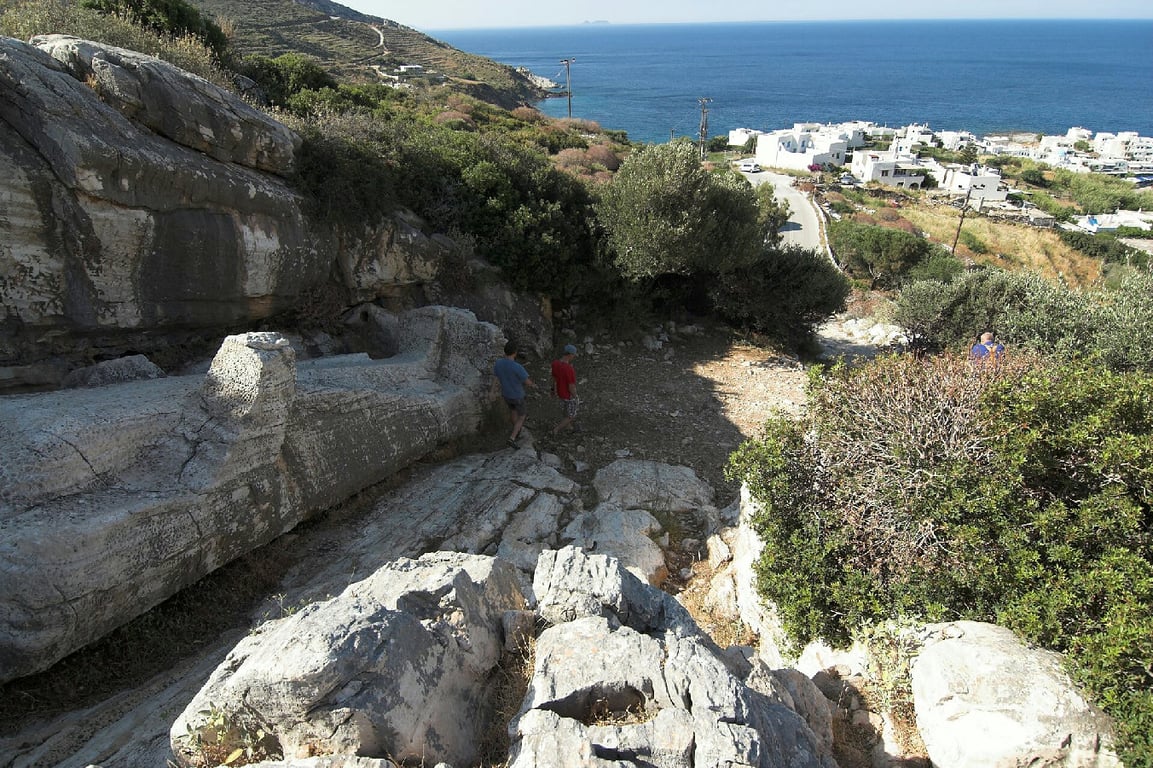
Colossal Kouros of Apollonas
A massive, unfinished marble statue of a kouros lies abandoned in an ancient quarry on Naxos, offering a direct glimpse into the methods of Archaic Greek sculptors.
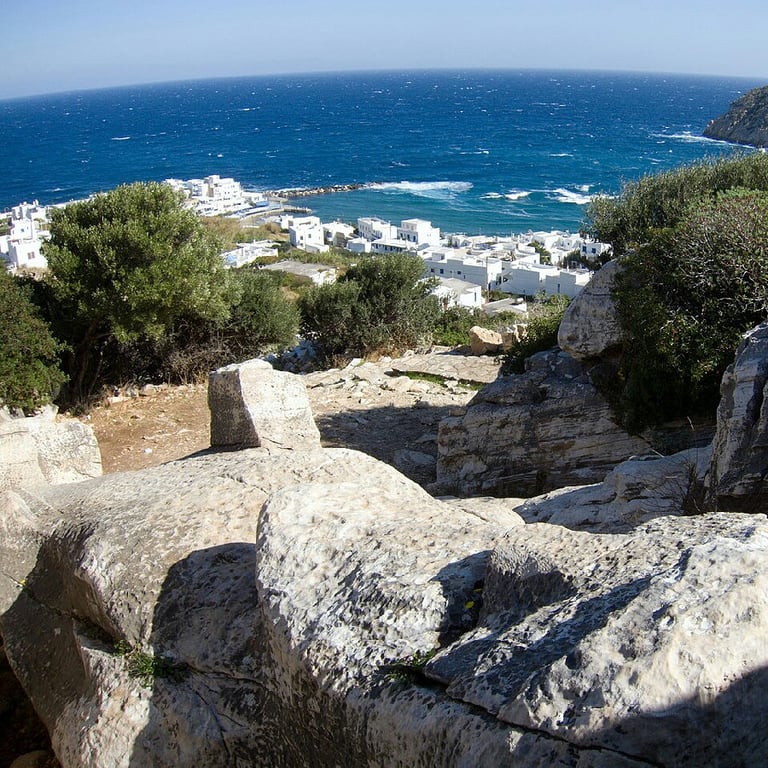
Colossal Kouros of Apollonas
In an ancient marble quarry on the northern coast of Naxos, near the fishing village of Apollonas, lies a remarkable testament to the ambition of Archaic Greek sculpture. Known as the Kouros of Apollonas, this colossal male figure rests on the ground, unfinished and never detached from the bedrock from which it was being carved. Measuring over 10.5 meters (about 34 feet) in length and weighing an estimated 80 tons, the statue offers an unparalleled glimpse into the monumental scale and technical processes of Greek stone carving in the 6th century BCE. Left in situ for more than 2,500 years, it serves as a powerful physical record of both the sculptor's intent and the immense challenges that could bring such a massive project to a halt.
A Window into Archaic Sculpting
The unfinished state of the kouros is its most valuable feature for archaeologists and historians. It allows us to trace the sculptor's work from the initial quarrying to the rough shaping of the human form. The figure is carved in the typical kouros pose: a rigid, frontal stance with the left leg advanced, arms held stiffly at the sides. The basic masses of the body, legs, and head have been hewn from the marble, but the features are indistinct and lack any fine detail. A rough beard is visible, and the general shape of the arms and feet can be discerned. Marks from the sculptors' tools, including points and chisels, are still visible on the surface, providing direct evidence of their carving techniques. The statue was likely abandoned after a significant crack appeared in the marble during the carving process, rendering the massive block unstable and worthless for its intended purpose.
The Identity of the Giant
While traditionally referred to as the "Kouros of Apollon" due to its proximity to Apollonas and a passing mention of a colossal statue of Apollo on Naxos by ancient writers, its true identity is a subject of scholarly debate. The presence of a beard on the roughly-carved face is unusual for a kouros (youth) and for the god Apollo, who was typically depicted as beardless. Some scholars suggest that the statue was intended to represent the god Dionysus, who had a strong cult following on the island of Naxos, his mythological birthplace. Regardless of its intended subject, the figure represents the Archaic Greek fascination with creating monumental votive offerings for sanctuaries, a practice that showcased the wealth of patrons and the skill of Naxian marble workers, who were among the most renowned in the Aegean.
The Quarries of Naxos
The Apollonas kouros is not an isolated phenomenon. Naxos was a major center for marble production in antiquity, and its high-quality marble was exported throughout the Greek world. Another giant, semi-finished kouros can be found in a quarry near the village of Flerio, further inland. Visiting the Apollonas kouros provides not only a direct encounter with a single, massive sculpture but also a deeper appreciation for the ancient industry that shaped the island's landscape and economy. Standing beside the immense, reclining figure, one can vividly imagine the teams of ancient craftsmen hammering and chiseling away at the stone, their ambitious project ultimately defeated by a flaw in the very material they sought to master.
The Stone Titan's Slumber: Secrets of the Apollonas Kouros
Beyond the staggering dimensions and the weight of 80 tons lies a deeper mystery, one that standard archaeology often overlooks. The Colossal Kouros of Apollonas is not just an unfinished statue; it is a silent oracle, a geologic ghost frozen in the act of becoming. While most accounts end with its abandonment due to a fatal crack, this is merely the first chapter in a story of cryptic identity, local superstition, and a possible connection to a global phenomenon of failed gigantism.
A Scar on the Sacred Stone
The common narrative that a single crack doomed the project is a dramatic oversimplification. Close examination reveals not one, but a series of fractures and fissures running through the marble. This suggests a prolonged, agonizing struggle between the sculptors and the very mountain they sought to master. Each flaw discovered would have been a devastating setback, a geological betrayal. Some geologists and archaeologists now theorize the project was an act of extreme hubris, an attempt to carve a figure so large from a piece of marble that was inherently unstable from the start, destined for failure before the first chisel ever struck.
The Whispering Marble of Naxos
The gargantuan figure has long been woven into the island's folklore, a place where the ancient gods never truly left. The statue is not seen by all locals as a failed work of art, but as a being intentionally bound to the earth. It is a powerful entity, a slumbering giant that was deliberately left connected to the bedrock to act as a guardian for the island of Naxos.
The Curse of the Bearded God
One persistent local legend warns that the figure is not Apollo, but a far older, more volatile deity. The story claims the sculptors were not carving a god, but attempting to imprison a powerful spirit within the stone. When the spirit fought back, it shattered the marble from within to prevent its own capture. According to the tale, the kouros was left unfinished as a warning: some powers are not meant to be contained by mortal hands. To this day, some islanders avoid the quarry after dark, believing the spirit grows restless.
A God, a Demon, or a Misunderstood Giant?
The statue's identity is one of its most profound debates. Its location near Apollonas suggests the god Apollo, but the crude beard is highly uncharacteristic of a typical, clean-shaven kouros. This has led to the prevailing scholarly theory that it represents Dionysus, whose cult was exceptionally strong on Naxos and who was often depicted with a beard in the Archaic period. The figure’s relaxed, almost reclining pose also deviates from the rigid, formal stance of other kouroi, further fueling speculation that it was never a kouros at all, but something else entirely—a unique monument for a specific, now-forgotten purpose.
The Global Pattern of Abandoned Titans
The Kouros of Apollonas does not lie in isolation. It belongs to a mysterious global family of unfinished monoliths, each abandoned in its quarry. The most famous is the Unfinished Obelisk in Aswan, Egypt, which, like the kouros, was abandoned after a flaw was discovered in the granite. Similarly, giant moai on Easter Island remain half-carved from the volcanic tuff of the Rano Raraku quarry. Is it merely a coincidence that ancient cultures across the globe, unconnected by trade or language, all suffered the same colossal failures? Or does this point to a shared technological barrier, a ritualistic purpose for leaving an eternal guardian in the "womb" of the earth, or a forgotten chapter of human ambition that consistently outpaced its ability?
Colossal Kouros of Apollonas — photo gallery