The Stone Forest
Towering limestone pillars blending natural wonder and ancient mystery near Varna.
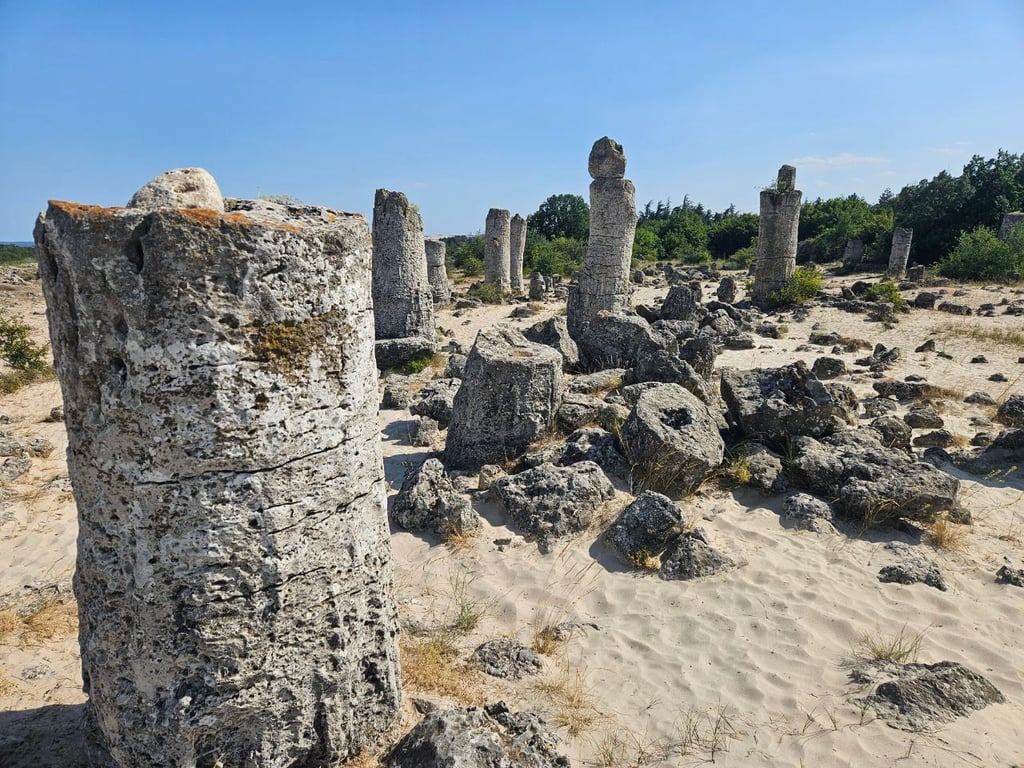
Nestled 18 km west of Varna, Bulgaria, Pobiti Kamani, or "The Stone Forest," is a captivating natural phenomenon spanning 7 square kilometers. This desert-like landscape, dotted with hundreds of limestone pillars up to 10 meters high and 3 meters thick, evokes the ruins of an ancient temple or a petrified forest.
Declared a natural landmark in the 1930s and now part of the Natura 2000 ecological network, Pobiti Kamani is celebrated as Bulgaria’s largest inland sand habitat, hosting unique flora, 21 bird species, and over 240 rare plant varieties. Its global significance is recognized through its tentative listing as a UNESCO World Heritage Site, with similar formations found only in Australia’s Shark Bay and Nambung National Park.
First documented in 1829 by Russian archaeologist Victor Teplyakov, who mistook the pillars for remnants of a cyclopean civilization, the site’s origins trace back 50 million years to the Cenozoic Era. The leading theory posits that these hollow and solid cylinders formed around methane seeps in a prehistoric seabed, where bacteria oxidized the gas into calcium carbonate tubes. Erosion later exposed these structures, creating the surreal landscape seen today. Alternative hypotheses suggest algal bio-buildups or coral complexes, though detailed studies have ruled out coral involvement. Ongoing research at Varna’s Oceanographic Institute continues to probe these mysteries, highlighting the site’s value for geological study.
Archaeologically, Pobiti Kamani reveals human presence from the Mesolithic era, with flint blades found in the surrounding sand, suggesting early fascination with its otherworldly forms. Local legends imbue the pillars - named “The Stone Guards,” “The Camel,” or “The Throne” - with mythical significance. One tale tells of titans, tasked with building the ancient Bulgarian capital Pliska, frozen into stone by divine will, their shapes forming a sacred landscape revered since antiquity.
Evolving from a sacred site to a protected natural monument, Pobiti Kamani reflects both geological and cultural history. Its stark beauty, set against sunflower fields, draws visitors to explore its seven pillar groups, with the “Center-South” cluster being the most striking. Accessible by car or public transport, the site offers a raw, uncommercialized experience, inviting reflection on nature’s artistry and humanity’s enduring connection to it. Pobiti Kamani stands as a testament to Earth’s ancient processes and Bulgaria’s rich heritage, a hidden gem that continues to captivate and mystify. Beyond its scientific intrigue, this site is steeped in local legends that have shaped its cultural significance for millennia. These myths, woven into the fabric of Bulgaria’s heritage, imbue the hollow, sand-filled columns - some 10 meters tall - with an aura of mysticism and divine intervention.
One prominent legend tells of a young man granted immortality by God, who revealed His sacred name with a warning: never share it. Enamored by a beautiful girl betrothed to the leader of sea titans, the young man struck a deal to win her freedom. To fulfill his promise, he arranged the titans on a beach to spell God’s name with their bodies. Enraged by this betrayal, God turned the titans to stone at sunrise, their frozen forms becoming the pillars of Pobiti Kamani. A miraculous spring, said to have gushed where the lovers reunited, adds a romantic flourish to the tale, linking the site to themes of sacrifice and divine justice.
Another myth casts the pillars as remnants of titans tasked with building Pliska, the ancient Bulgarian capital. When they failed or defied divine will, they were petrified, their towering forms left as a warning. These stories reflect ancient Bulgarian beliefs in supernatural forces and cosmic retribution, with the pillars - named “The Stone Guards,” “The Camel,” or “The Throne” - seen as sacred sentinels emanating mystical energy.
Archaeological finds, like Mesolithic flint blades, suggest the site’s sanctity predates written history, likely inspiring these tales. The pillars’ eerie, human-like shapes fueled local imagination, with formations like “The Soldier” or “The Stone of Fertility” embodying spiritual significance. Today, Pobiti Kamani remains a spiritual haven, its legends drawing visitors to ponder the interplay of nature, myth, and human reverence in a landscape that feels otherworldly
Declared a natural landmark in the 1930s and now part of the Natura 2000 ecological network, Pobiti Kamani is celebrated as Bulgaria’s largest inland sand habitat, hosting unique flora, 21 bird species, and over 240 rare plant varieties. Its global significance is recognized through its tentative listing as a UNESCO World Heritage Site, with similar formations found only in Australia’s Shark Bay and Nambung National Park.
First documented in 1829 by Russian archaeologist Victor Teplyakov, who mistook the pillars for remnants of a cyclopean civilization, the site’s origins trace back 50 million years to the Cenozoic Era. The leading theory posits that these hollow and solid cylinders formed around methane seeps in a prehistoric seabed, where bacteria oxidized the gas into calcium carbonate tubes. Erosion later exposed these structures, creating the surreal landscape seen today. Alternative hypotheses suggest algal bio-buildups or coral complexes, though detailed studies have ruled out coral involvement. Ongoing research at Varna’s Oceanographic Institute continues to probe these mysteries, highlighting the site’s value for geological study.
Archaeologically, Pobiti Kamani reveals human presence from the Mesolithic era, with flint blades found in the surrounding sand, suggesting early fascination with its otherworldly forms. Local legends imbue the pillars - named “The Stone Guards,” “The Camel,” or “The Throne” - with mythical significance. One tale tells of titans, tasked with building the ancient Bulgarian capital Pliska, frozen into stone by divine will, their shapes forming a sacred landscape revered since antiquity.
Evolving from a sacred site to a protected natural monument, Pobiti Kamani reflects both geological and cultural history. Its stark beauty, set against sunflower fields, draws visitors to explore its seven pillar groups, with the “Center-South” cluster being the most striking. Accessible by car or public transport, the site offers a raw, uncommercialized experience, inviting reflection on nature’s artistry and humanity’s enduring connection to it. Pobiti Kamani stands as a testament to Earth’s ancient processes and Bulgaria’s rich heritage, a hidden gem that continues to captivate and mystify. Beyond its scientific intrigue, this site is steeped in local legends that have shaped its cultural significance for millennia. These myths, woven into the fabric of Bulgaria’s heritage, imbue the hollow, sand-filled columns - some 10 meters tall - with an aura of mysticism and divine intervention.
One prominent legend tells of a young man granted immortality by God, who revealed His sacred name with a warning: never share it. Enamored by a beautiful girl betrothed to the leader of sea titans, the young man struck a deal to win her freedom. To fulfill his promise, he arranged the titans on a beach to spell God’s name with their bodies. Enraged by this betrayal, God turned the titans to stone at sunrise, their frozen forms becoming the pillars of Pobiti Kamani. A miraculous spring, said to have gushed where the lovers reunited, adds a romantic flourish to the tale, linking the site to themes of sacrifice and divine justice.
Another myth casts the pillars as remnants of titans tasked with building Pliska, the ancient Bulgarian capital. When they failed or defied divine will, they were petrified, their towering forms left as a warning. These stories reflect ancient Bulgarian beliefs in supernatural forces and cosmic retribution, with the pillars - named “The Stone Guards,” “The Camel,” or “The Throne” - seen as sacred sentinels emanating mystical energy.
Archaeological finds, like Mesolithic flint blades, suggest the site’s sanctity predates written history, likely inspiring these tales. The pillars’ eerie, human-like shapes fueled local imagination, with formations like “The Soldier” or “The Stone of Fertility” embodying spiritual significance. Today, Pobiti Kamani remains a spiritual haven, its legends drawing visitors to ponder the interplay of nature, myth, and human reverence in a landscape that feels otherworldly
The Stone Forest — photo gallery


The Stone Forest — collectible cards
Collectible cards for this site — AI-generated illustrations from our memory game, not photographs of the site.