The Dhamar Crater
Yemen's raw volcanic heart, forged by ancient eruptions, whispering tales of Earth's untamed power.
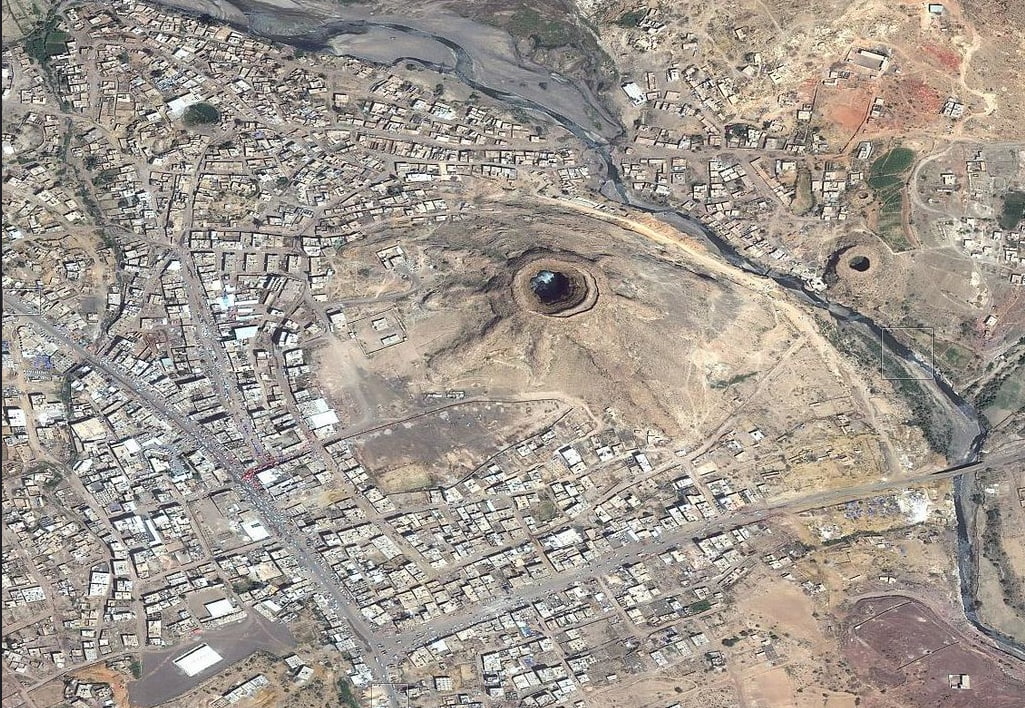
Located in the rugged volcanic landscape of Yemen’s Dhamar Governorate, the Dhamar Crater near the town of Damt is a striking geological feature within the Harras of Dhamar volcanic field. This expansive, circular depression, formed by ancient volcanic activity, captivates geologists and adventurers alike. Spanning part of Yemen’s Western Volcanic Plateau, the crater is a testament to the region’s dynamic tectonic history, shaped by the rifting of the Red Sea and Gulf of Aden.
The Dhamar Crater is likely a maar, a low-relief volcanic crater formed by phreatomagmatic eruptions—explosive interactions between magma and groundwater. These eruptions create broad, shallow craters, often surrounded by low rims of ejected material like ash and basalt. The crater’s steep, symmetrical walls and flat floor suggest a violent formation, possibly within the last 10,000 years during the Holocene epoch. Its dark basaltic rim contrasts with the surrounding reddish rhyolitic rocks, hinting at multiple eruptive phases. Nearby geothermal springs, with temperatures of 40-45°C, indicate lingering subsurface heat, raising interest in potential geothermal energy.
This formation is not unique to Yemen. Similar maars dot volcanic regions worldwide, such as the Eifel Volcanic Field in Germany, home to the Laacher See maar, or the Auckland Volcanic Field in New Zealand, with its well-preserved Rangitoto craters. Like Dhamar, these features arise in rift zones or hotspots where magma interacts with water, creating explosive craters. The Espenberg maars in Alaska, among the largest known, share Dhamar’s broad, circular morphology. These global analogs highlight how tectonic settings—rift zones, in Dhamar’s case—produce such dramatic landscapes.
The Dhamar Crater’s significance extends beyond geology. It lies in a seismically active region, with the 1982 Dhamar earthquake (magnitude ~6.0) underscoring the area’s tectonic volatility. While no eruptions have occurred since a possible 1937 event in the broader field, the crater’s youth suggests potential for future activity, though risks remain low. Its fertile volcanic soils support local agriculture, and the stark landscape, dotted with ancient mosques built from volcanic stone, blends natural and cultural heritage.
Scientific interest in the crater is growing, with studies from the 1990s to 2020s exploring geothermal prospects in Damt and nearby Al Lisi. However, Yemen’s ongoing conflict limits research and tourism. For those intrigued, satellite imagery on platforms like Google Earth reveals the crater’s dramatic scale, while the Smithsonian’s Global Volcanism Program offers detailed maps. The Dhamar Crater stands as a window into Earth’s fiery past, inviting comparisons to similar formations worldwide and sparking curiosity about its origins and future. the crater evokes comparisons to both modern and prehistoric trees, reflecting Earth’s vibrant geological and biological history.
The crater’s tree-like form recalls modern giants like California’s sequoias, which soar to 300 feet and thrive in nutrient-rich, volcanic soils. Dhamar’s fertile plateau, enriched by basaltic lava and ash, mirrors these conditions, supporting local agriculture. Such volcanic landscapes provide ideal grounds for massive trees, with nutrients fostering robust growth. The crater’s resemblance to a stump suggests a natural artistry, where geology mimics biology in Yemen’s tectonically active rift zone.
Prehistoric trees, like the Devonian Archaeopteris, which reached 100 feet in warm, wet climates, deepen the connection. These ancient giants grew near volcanic zones, much like Dhamar’s rift-driven setting. Fossilized stumps in New York’s Gilboa forest resemble the crater’s circular form, hinting at a shared legacy. Ancient Yemen, with its geothermal springs (40-45°C) near Damt, likely had the CO2-rich, waterlogged conditions that nurtured such trees. The crater’s shape echoes these fossilized relics, linking volcanic activity to ancient forests.
While no direct evidence links the Dhamar Crater to fossilized trees, its tree-like silhouette sparks curiosity about volcanic landscapes as cradles for ancient forests. Today, Yemen’s conflict limits exploration, but satellite imagery reveals the crater’s uncanny form, inviting comparisons to both living giants and extinct titans. The Dhamar Crater stands as a geological relic, bridging Yemen’s volcanic present with the arboreal ghosts of Earth’s distant past.
The Dhamar Crater is likely a maar, a low-relief volcanic crater formed by phreatomagmatic eruptions—explosive interactions between magma and groundwater. These eruptions create broad, shallow craters, often surrounded by low rims of ejected material like ash and basalt. The crater’s steep, symmetrical walls and flat floor suggest a violent formation, possibly within the last 10,000 years during the Holocene epoch. Its dark basaltic rim contrasts with the surrounding reddish rhyolitic rocks, hinting at multiple eruptive phases. Nearby geothermal springs, with temperatures of 40-45°C, indicate lingering subsurface heat, raising interest in potential geothermal energy.
This formation is not unique to Yemen. Similar maars dot volcanic regions worldwide, such as the Eifel Volcanic Field in Germany, home to the Laacher See maar, or the Auckland Volcanic Field in New Zealand, with its well-preserved Rangitoto craters. Like Dhamar, these features arise in rift zones or hotspots where magma interacts with water, creating explosive craters. The Espenberg maars in Alaska, among the largest known, share Dhamar’s broad, circular morphology. These global analogs highlight how tectonic settings—rift zones, in Dhamar’s case—produce such dramatic landscapes.
The Dhamar Crater’s significance extends beyond geology. It lies in a seismically active region, with the 1982 Dhamar earthquake (magnitude ~6.0) underscoring the area’s tectonic volatility. While no eruptions have occurred since a possible 1937 event in the broader field, the crater’s youth suggests potential for future activity, though risks remain low. Its fertile volcanic soils support local agriculture, and the stark landscape, dotted with ancient mosques built from volcanic stone, blends natural and cultural heritage.
Scientific interest in the crater is growing, with studies from the 1990s to 2020s exploring geothermal prospects in Damt and nearby Al Lisi. However, Yemen’s ongoing conflict limits research and tourism. For those intrigued, satellite imagery on platforms like Google Earth reveals the crater’s dramatic scale, while the Smithsonian’s Global Volcanism Program offers detailed maps. The Dhamar Crater stands as a window into Earth’s fiery past, inviting comparisons to similar formations worldwide and sparking curiosity about its origins and future. the crater evokes comparisons to both modern and prehistoric trees, reflecting Earth’s vibrant geological and biological history.
The crater’s tree-like form recalls modern giants like California’s sequoias, which soar to 300 feet and thrive in nutrient-rich, volcanic soils. Dhamar’s fertile plateau, enriched by basaltic lava and ash, mirrors these conditions, supporting local agriculture. Such volcanic landscapes provide ideal grounds for massive trees, with nutrients fostering robust growth. The crater’s resemblance to a stump suggests a natural artistry, where geology mimics biology in Yemen’s tectonically active rift zone.
Prehistoric trees, like the Devonian Archaeopteris, which reached 100 feet in warm, wet climates, deepen the connection. These ancient giants grew near volcanic zones, much like Dhamar’s rift-driven setting. Fossilized stumps in New York’s Gilboa forest resemble the crater’s circular form, hinting at a shared legacy. Ancient Yemen, with its geothermal springs (40-45°C) near Damt, likely had the CO2-rich, waterlogged conditions that nurtured such trees. The crater’s shape echoes these fossilized relics, linking volcanic activity to ancient forests.
While no direct evidence links the Dhamar Crater to fossilized trees, its tree-like silhouette sparks curiosity about volcanic landscapes as cradles for ancient forests. Today, Yemen’s conflict limits exploration, but satellite imagery reveals the crater’s uncanny form, inviting comparisons to both living giants and extinct titans. The Dhamar Crater stands as a geological relic, bridging Yemen’s volcanic present with the arboreal ghosts of Earth’s distant past.
The Dhamar Crater — photo gallery
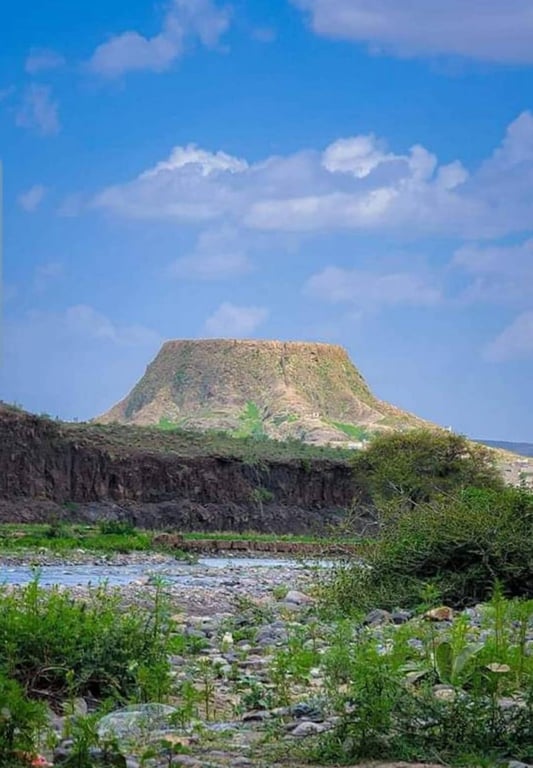
The Dhamar Crater — collectible cards
Collectible cards for this site — AI-generated illustrations from our memory game, not photographs of the site.