Petra
Ancient city carved into rose-colored stone cliffs.
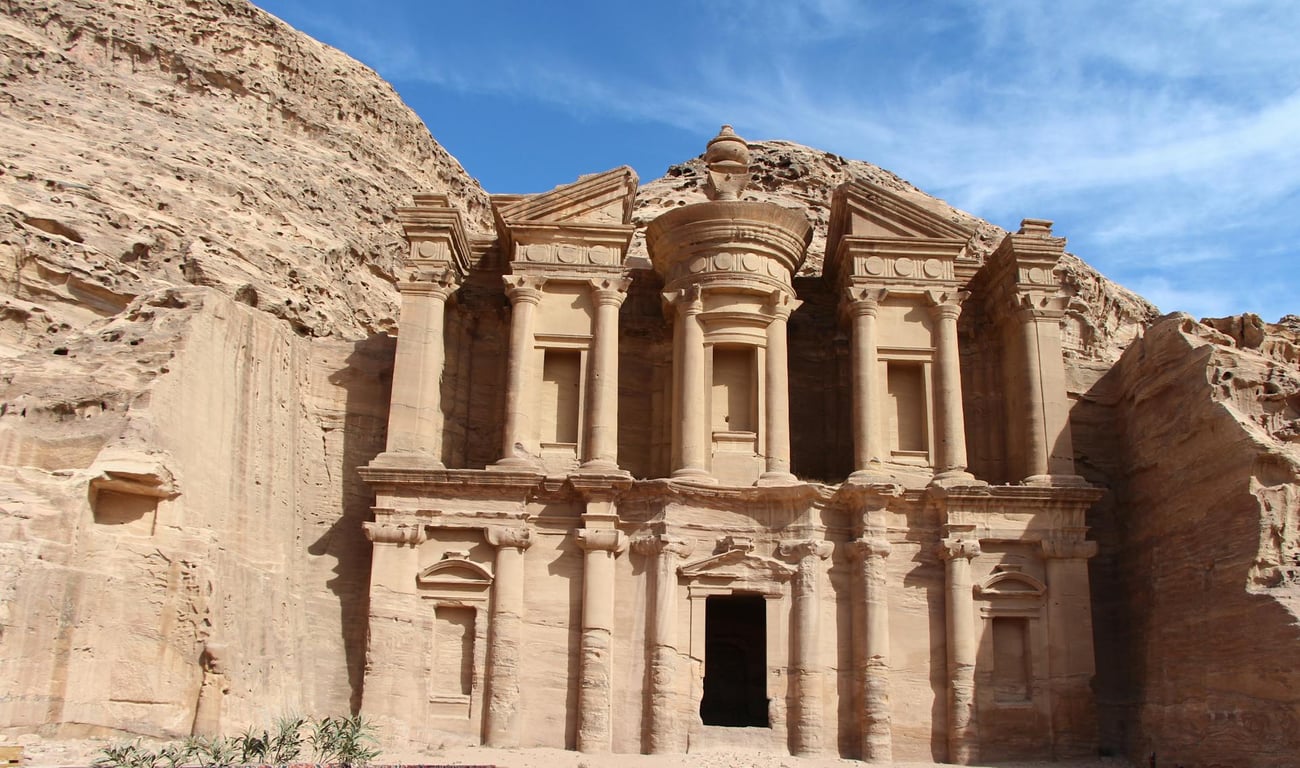
Nestled in the rugged mountains of modern-day Jordan, the ancient city of Petra stands as a breathtaking testament to human ingenuity and enduring civilization. Often referred to as the "Rose-Red City" due to the striking color of the sandstone from which it is carved, Petra is a mesmerizing archaeological wonder that captivates visitors with its dramatic architecture, intricate water systems, and profound historical narrative.
This UNESCO World Heritage Site and one of the New7Wonders of the World offers a unique glimpse into the lives of the Nabataeans, a prosperous Arab people who transformed a desert landscape into a thriving metropolis and vital trade hub thousands of years ago.
The Rose-Red City's Ancient Roots
The origins of Petra stretch back into antiquity, with evidence of human settlement dating as far back as the Bronze Age. However, it was the Nabataeans, an ancient Bedouin people, who truly sculpted Petra into the magnificent capital city we largely recognize today. Arriving in the region around the 6th century BCE, they meticulously carved their homes, temples, and tombs directly into the towering sandstone cliffs, creating a city that blended seamlessly with its natural surroundings. Petra's strategic location along major ancient trade routes, connecting Mesopotamia with Egypt and Syria with Arabia, allowed the Nabataeans to control the flow of frankincense, myrrh, spices, and other valuable goods, accumulating immense wealth and influence.
Nabataea's Desert Empire
At its zenith, the Nabataean Kingdom was a formidable power, and Petra served as its vibrant heart. The city's prosperity was not solely built on trade; the Nabataeans were also masterful engineers, developing sophisticated water collection and storage systems that allowed a large population to flourish in an arid environment.
Despite eventually being annexed by the Roman Empire in 106 CE, Petra continued to thrive for centuries under Roman rule, adapting Roman architectural styles while retaining its distinctive Nabataean character. Its decline began with shifts in trade routes and devastating earthquakes in the 4th and 6th centuries CE, leading to its eventual abandonment and becoming a "lost city" to the Western world until its rediscovery in 1812.
A Symphony in Sandstone
Petra's most distinctive feature is its extraordinary rock-cut architecture, where entire structures are hewn directly from the living rock face. This unique building technique creates an unparalleled visual spectacle, with facades of intricate detail emerging from the natural contours of the cliffs. The monumental scale and artistic precision of these carvings showcase the unparalleled skill of Nabataean artisans.
The Siq's Dramatic Entrance
Access to the main city of Petra is an experience in itself, beginning with the Siq – a narrow, winding canyon that stretches for over a kilometer. Towering cliffs, sometimes reaching 80 meters high, flank this natural gorge, creating an awe-inspiring passageway. The Siq not only served as the primary entrance but also offered natural defense, culminating in a dramatic reveal of Petra's most iconic masterpiece.
Al-Khazneh's Enduring Mystique
Emerging from the shadowy confines of the Siq, visitors are greeted by the magnificent Al-Khazneh, or "The Treasury." This iconic structure, with its elaborate Hellenistic-inspired façade, is perhaps the most famous image of Petra. Despite its popular name, The Treasury was likely built as a tomb for a Nabataean king in the 1st century CE. Its perfectly preserved carvings and intricate details, carved into the rose-red sandstone, continue to inspire wonder and speculation about its true purpose and the secrets it holds. Beyond The Treasury, hundreds of other rock-cut tombs, temples, and residential structures dot the landscape, including the colossal Ad Deir (The Monastery) perched high above the city.
Echoes of Ingenuity and Devotion
Petra's significance extends beyond its architectural grandeur, encompassing its role as a cultural melting pot, a marvel of ancient engineering, and a site of ongoing archaeological discovery. It was a place where diverse cultures intersected, leaving behind a rich tapestry of art, religion, and innovation.
Water's Lifeline in the Desert
The Nabataeans’ mastery of water management was crucial to Petra's survival and prosperity. They engineered an elaborate network of dams, cisterns, channels, and ceramic pipes to collect, store, and distribute water throughout the city, even during dry seasons. This sophisticated system allowed them to sustain a large population and cultivate gardens in the arid desert, a testament to their advanced hydrological knowledge.
Whispers from Newly Unearthed Tombs
Even today, Petra continues to reveal its secrets. Recent archaeological expeditions have uncovered new insights into the city's past, including the discovery of previously unknown tombs and structures. For instance, a notable discovery in late 2024 of a well-preserved tomb complex offers fresh perspectives on Nabataean burial practices and societal structure, underscoring the vast amount of Petra's history that still lies beneath the sand, awaiting exploration and study.
Guarding the Rose-Red Legacy: Petra in the Modern Era
Today, Petra stands as a jewel of Jordan and a global treasure, attracting hundreds of thousands of visitors annually who come to marvel at its ancient beauty. Its status as a UNESCO World Heritage Site since 1985 underscores its "outstanding universal value" and the international commitment to its preservation.
Maintaining Petra's integrity in the face of natural erosion, seismic activity, and the pressures of modern tourism is a continuous challenge. Extensive conservation efforts are underway, employing both traditional methods and advanced technology to protect the fragile sandstone structures and ensure that future generations can continue to experience the awe-inspiring grandeur of this ancient city. Petra remains a vibrant archaeological site, an open-air museum, and a powerful symbol of human endurance and artistic achievement.
Beyond the iconic Treasury and the Monastery, Petra, the ancient Nabataean capital, pulses with a deeper, more enigmatic energy. While its dramatic facades are globally recognized, countless secrets remain locked within its rose-red cliffs and beneath its shifting sands. For the open-minded seeker and the curious enthusiast, Petra offers more than just history; it presents a canvas for unproven theories, whispered legends, and archaeological questions that challenge conventional understanding.
The Unseen City Beneath the Rose
While millions marvel at Petra's visible monuments, a staggering 85% of the ancient city is believed to remain unexcavated, buried under centuries of sand and debris. This vast, unexplored expanse hints at an entire hidden metropolis waiting to be discovered. Recent satellite imagery and drone surveys have unveiled monumental structures, including a massive platform larger than a football field, just beneath the surface, suggesting that what we see today is merely the tip of an archaeological iceberg. What complex networks of dwellings, temples, and workshops might lie beneath, holding clues to a civilization far more extensive and sophisticated than currently understood?
Whispers of the Djinn and Serpent Guardians
Local Bedouin folklore imbues Petra with a potent mystical aura, speaking of powerful entities that predate human presence. Legends recount tales of Djinn, ethereal beings believed to inhabit the countless caves and tombs, guarding ancient treasures and secrets. The most famous of these tales surrounds Al-Khazneh, the Treasury, said to be protected by a colossal serpent whose presence wards off intruders. Generations of locals have left offerings at specific niches, not for Nabataean deities, but to appease these powerful spirits of the rock, acknowledging a supernatural dimension that coexists with the tangible ruins.
The Treasury's Cursed Veil
One particular legend posits that the Treasury is not merely a tomb, but a repository of immense magical power, protected by a curse that befalls anyone attempting to breach its inner sanctum without pure intent. This tale, passed down through oral tradition, cautions against desecration, suggesting that the Nabataeans wove not just architectural marvels but also spiritual safeguards into the very fabric of their city.
The Enigma of Petra's Architects: Impossible Feats?
The sheer scale and precision of Petra's rock-cut architecture continue to baffle modern engineers. While the accepted theory of carving from the top down explains the general methodology, it fails to fully account for the intricate details, perfect symmetry, and monumental height achieved without visible scaffolding or advanced tools. How did the Nabataeans manage such flawless execution, often hundreds of feet above the valley floor, with only primitive chisels and hammers? Some theories propose a lost understanding of rock mechanics, an unknown form of scaffolding, or even a system of advanced geometry and acoustics that allowed them to "see" the finished product within the raw stone, guiding their hand with uncanny accuracy.
Echoes from Distant Sands: A Global Blueprint?
Petra's unique rock-cut architecture shares curious parallels with other ancient sites across the globe, from the Lycian tombs of Turkey to the monolithic temples of Lalibela in Ethiopia and the cave complexes of Ajanta and Ellora in India. Is this merely a coincidence of human ingenuity, or does it hint at a shared, ancient knowledge of construction and sacred geometry that transcended geographical boundaries? Some theorists suggest a "global pattern" of such sites, proposing that these civilizations might have been influenced by a common, yet lost, master tradition or even strategically placed along ancient energetic ley lines. Petra, with its precise water management and celestial alignments, could be a key piece in deciphering this enigmatic global blueprint, connecting it to a much larger, forgotten narrative of human history.
Petra — photo gallery


Petra — collectible cards
Collectible cards for this site — AI-generated illustrations from our memory game, not photographs of the site.